The Ultimate Guide to Scrum Mastery in Trivandrum
Accelerate your Agile career with deep insights into CSM Certification Training in Trivandrum, career opportunities, and proven strategies for Scrum Masters in Kerala's IT Hub.
Why Choose CSM Certification Training In Trivandrum?
In an era defined by rapid technological advancements and fluctuating market demands, organizations can no longer rely on rigid, linear project management methodologies like Waterfall. The necessity for adaptability, speed, and continuous improvement has driven the widespread adoption of the Agile mindset, and consequently, the Scrum framework. For professionals located in rapidly growing tech ecosystems like Trivandrum, choosing to undergo Certified ScrumMaster (CSM) Certification Training is a transformative career decision that aligns perfectly with modern industry requirements across Kerala and the global IT landscape.
But why choose the CSM certification specifically, over other available Agile credentials? The answer lies in the unmatched prestige and rigorous standard set by the Scrum Alliance, the oldest, most established certifying body in the Agile domain. Unlike self-paced certifications that only require candidates to pass a theoretical multiple-choice exam, the CSM Certification Training in Trivandrum mandates attendance at a highly interactive, 2-day live workshop (either virtual or in-person) led exclusively by a Certified Scrum Trainer (CST). This instructional format guarantees that candidates are not merely memorizing definitions from the Scrum Guide, but are actively engaging in practical exercises, group simulations, and case studies that mimic real-world software development and complex business challenges.
During this comprehensive CSM Certification Training in Trivandrum, participants deep dive into the core values of Agile—individuals and interactions, working software, customer collaboration, and responding to change. You learn to embrace the three empirical pillars of Scrum: Transparency, Inspection, and Adaptation. By understanding how to apply these pillars daily, you become equipped to guide teams away from chaotic, undocumented work processes toward structured, value-driven Sprints that deliver measurable results.
Furthermore, CSM training fundamentally alters your leadership perspective. It teaches you how to transition from traditional "command-and-control" management to Servant Leadership. Instead of assigning tasks and tracking hours meticulously, you learn how to foster self-organizing, cross-functional teams that take true ownership of their work. For professionals in Trivandrum aiming to break into top-tier tech startups at Technopark, multinational IT corporations, or looking to facilitate organizational change across non-IT sectors such as healthcare, education, and government operations, the CSM certification serves as a verifiable benchmark of excellence.
Growing Demand for Certified Scrum Masters in Trivandrum’s Ecosystem
Trivandrum (Thiruvananthapuram) has rapidly evolved into one of the most prominent industrial, educational, and technology hubs in South India. With the continuous expansion of Technopark (India's largest IT park), Technocity, and KINFRA parks, the city is a magnet for global technology giants, mid-sized IT service providers, and innovative startups. This massive regional expansion has triggered a surging demand for professionals who have completed CSM Certification Training in Trivandrum.
Organizations operating in and around Trivandrum are no longer restricted to legacy maintenance projects. They are building cloud-native applications, AI-driven enterprise platforms, digital healthcare solutions, and space-tech innovations. To stay competitive with global delivery standards, these organizations rely heavily on Agile and Scrum practices to reduce time-to-market. Consequently, recruiters in Kerala actively prioritize candidates who hold a globally recognized Certified ScrumMaster (CSM) credential from the Scrum Alliance.
- IT Services & Technopark Companies: Leading IT firms situated in Trivandrum require Certified Scrum Masters to lead cross-functional development teams, streamline Sprint deliveries, and coordinate seamlessly with international clients in the US, Europe, and the Middle East.
- Healthcare & EdTech: With Kerala's focus on high-quality healthcare and education, companies are adopting Agile project management and Scrum frameworks to modernize telemedicine platforms, hospital management software, and e-learning portals.
- Government & Public Sector Digitalization: The push for e-governance in Kerala means even public sector projects benefit immensely from Agile frameworks to deliver citizen services incrementally and securely.
- Remote Global Opportunities: Completing CSM Certification Training in Trivandrum also qualifies local professionals for high-paying remote Scrum Master and Agile Coach roles with multinational companies worldwide, allowing you to work globally while enjoying the quality of life in Kerala.
By earning your credential through CSM Certification Training in Trivandrum, you position yourself at the forefront of this regional economic boom, bridging the gap between technical execution and strategic business outcomes. You become the linchpin that helps businesses transition into agile, tech-first enterprises.
Career Opportunities After CSM Certification in Trivandrum
Acquiring a Certified Scrum Master credential is not just an educational milestone; it is a gateway to a myriad of highly rewarding and diverse career opportunities. The global shift toward digital transformation has generated a massive skills gap in the market, creating an unprecedented demand for professionals who know how to optimize workflows and reduce time-to-market. Trivandrum’s rapidly evolving corporate landscape, combined with the normalization of remote and hybrid work across the globe, ensures that professionals completing CSM Certification Training in Trivandrum are uniquely positioned to capitalize on this demand.
The most immediate and traditional career path following certification is assuming the role of a Scrum Master. In this role, your primary responsibility is to act as a servant-leader for the Scrum Team. You become the ultimate facilitator—ensuring that the team understands and adheres to Scrum theory, practices, and rules. You are tasked with identifying and removing impediments (blockers) that prevent the Developers from achieving their Sprint Goal. You also coach the Product Owner on effective Product Backlog management and help the organization at large understand the value of empirical product development.
However, the value of the CSM extends far beyond the strict title of Scrum Master. Many certified professionals naturally evolve into Agile Coaches. As an Agile Coach, the scope of influence scales from a single team to multiple teams, departments, or even the entire enterprise. Agile Coaches are highly compensated experts responsible for designing and executing organizational Agile transformations, mentoring leadership on Lean-Agile mindsets, and establishing continuous integration and continuous delivery (CI/CD) pipelines from a process standpoint. Here are some key roles you can target:
- Agile Delivery Manager: Focuses on the end-to-end delivery of products, utilizing Scrum frameworks to ensure that cross-functional teams meet their release targets predictably, efficiently, and with high quality.
- Product Owner/Product Manager: While there is a specific CSPO certification, having a CSM background allows Product Managers to deeply understand the mechanics of the development team, leading to better-refined backlogs, realistic release plans, and a highly collaborative team environment.
- Project Manager transitioning to Agile: For traditional PMP-certified managers in Trivandrum, adding a CSM is a strategic pivot that modernizes their skill set, allowing them to lead hybrid or fully Agile projects seamlessly without being bogged down by outdated Waterfall constraints.
- Release Train Engineer (RTE): In larger organizations scaling Agile using frameworks like SAFe, experienced Scrum Masters often step into the RTE role to facilitate Agile Release Trains, steering multiple teams toward a unified program increment.
From a financial perspective, the ROI on CSM Certification Training in Trivandrum is exceptionally high. Industry surveys consistently indicate that certified Scrum professionals command a significant salary premium over their uncertified peers. Employers recognize that a certified professional brings verified methodologies that drastically reduce wasted time and failed projects, making the Scrum Master an invaluable asset to the company's bottom line.
Deep Dive Into The Scrum Framework: Pillars, Values, Accountabilities, Events, and Artifacts
A major advantage of enrolling in CSM Certification Training in Trivandrum is gaining an unshakable, practical mastery of the Scrum Framework as defined in the latest Scrum Guide. Scrum is purposefully lightweight and simple to understand, yet it requires structured discipline to master. Rather than providing detailed, rigid instructions for every possible scenario, Scrum establishes a boundary of rules, accountabilities, events, and artifacts within which self-managing teams can solve complex adaptive problems creatively and productively.
At the heart of CSM Certification Training in Trivandrum is Empirical Process Control Theory, or empiricism, combined with Lean thinking. Empiricism asserts that knowledge comes from real experience and making decisions based on what is observed, while Lean thinking reduces waste and focuses strictly on essential value. During the training workshop, Certified Scrum Trainers break down how the three empirical pillars uphold every single Scrum implementation across any industry:
- Transparency: The emergent process and work must be visible to those performing the work as well as those receiving the work. Important decisions in Scrum are based on the perceived state of its three formal artifacts. Artifacts that have low transparency can lead to decisions that diminish value and increase risk.
- Inspection: The Scrum artifacts and the progress toward agreed goals must be inspected frequently and diligently to detect potentially undesirable variances or problems. To help with inspection, Scrum provides cadence in the form of its five formal events, ensuring that teams don't go too long without checking their work.
- Adaptation: If any aspect of a process deviates outside acceptable limits or if the resulting product is unacceptable, the process being applied or the materials being produced must be adjusted. The adjustment must be made as soon as possible to minimize further deviation and waste.
Successful use of Scrum depends on people becoming more proficient in living five core Scrum Values: Commitment, Focus, Openness, Respect, and Courage. The Scrum Team commits to achieving its goals and to supporting each other. Their primary focus is on the work of the Sprint to make the best possible progress toward these goals. The Scrum Team and its stakeholders are open about the work and the challenges. Scrum Team members respect each other to be capable, independent people, and are respected as such by the people with whom they work. Finally, the Scrum Team members have the courage to do the right thing and work on tough, complex problems.
In CSM Certification Training in Trivandrum, you also explore the three specific accountabilities within a Scrum Team—Scrum Master, Product Owner, and Developers—along with the five formal events (The Sprint, Sprint Planning, Daily Scrum, Sprint Review, and Sprint Retrospective) and the three artifacts paired with their commitments (Product Backlog with the Product Goal, Sprint Backlog with the Sprint Goal, and the Increment with the Definition of Done). Understanding how these elements interact ensures that teams in Trivandrum deliver high-value increments every single Sprint.
CSM vs. PSM vs. PMI-ACP: Which Agile Certification is Best for Professionals in Trivandrum?
When professionals decide to upskill in Agile methodologies, they frequently encounter multiple certifications such as Certified ScrumMaster (CSM) by Scrum Alliance, Professional Scrum Master (PSM) by Scrum.org, and Agile Certified Practitioner (PMI-ACP) by the Project Management Institute. Understanding why CSM Certification Training in Trivandrum remains the most preferred and widely recognized choice helps you make an informed investment in your career trajectory.
The primary differentiator of the CSM certification is its experiential learning mandate. While exams like PSM I allow candidates to study on their own without attending an official class, the Scrum Alliance recognizes that Scrum mastery is fundamentally about human behavior, facilitation, empathy, and real-time coaching—skills that cannot be learned solely from reading a PDF document. Therefore, CSM Certification Training in Trivandrum requires 16 hours of live, interactive instruction under a Certified Scrum Trainer (CST). Employers value this mandatory training because it guarantees that a CSM holder has actually practiced Sprint ceremonies, backlog refinement, and conflict resolution in a collaborative, simulated environment.
- Global Brand Recognition: CSM is the pioneer of Scrum certifications and remains the most frequently requested Agile keyword in job descriptions across job portals in Trivandrum, Kochi, and worldwide.
- No Prior Experience Barrier: Unlike PMI-ACP, which requires thousands of hours of prior project management and Agile experience before you can even apply for the exam, CSM Certification Training in Trivandrum welcomes both fresh graduates and seasoned managers alike.
- High First-Attempt Success Rate: With a 50-question open-book exam, a 74% passing score, and two free attempts within 90 days included in your CSM Certification Training in Trivandrum package, candidates enjoy a smooth, stress-free certification journey that builds confidence.
- Clear Career Progression Path: CSM serves as the foundational stepping stone toward prestigious advanced credentials from Scrum Alliance, including A-CSM (Advanced), CSP-SM (Professional), and enterprise leadership certifications like CAL (Certified Agile Leader).
For professionals who want immediate industry credibility, hands-on mentorship from an elite CST, and access to an active global community, choosing CSM Certification Training in Trivandrum delivers unmatched long-term career value and networking opportunities.
Step-by-Step Roadmap to Becoming CSM Certified in Trivandrum
At EasyLearningTre, we have streamlined the entire journey of CSM Certification Training in Trivandrum so that working professionals can earn their global credential over a single weekend without disrupting their busy work schedules. From enrollment to downloading your official certificate and digital badge, every step is guided and supported by our dedicated training coordination team.
- Step 1 – Select Your Batch & Enroll: Browse the upcoming weekday or weekend batches on our CSM Training Certification Schedule in Trivandrum and complete a quick, hassle-free registration process online.
- Step 2 – Access Pre-Course Study Materials: Immediately upon enrollment, receive the latest Scrum Guide, pre-reading handouts, and preparatory eBooks to familiarize yourself with foundational Scrum terminology before the class begins.
- Step 3 – Attend the 2-Day Live Virtual Workshop: Join 16 hours of immersive, activity-based training led by a Scrum Alliance Certified Scrum Trainer (CST). Participate in group simulations, role-plays, and real-time Q&A sessions to solidify your knowledge.
- Step 4 – Activate Your Scrum Alliance Account: Upon completing the 2-day workshop, your CST uploads your attendance details to the Scrum Alliance portal, triggering an official welcome email that prompts you to activate your profile.
- Step 5 – Clear the Online CSM Exam: Log in to your Scrum Alliance dashboard and complete the 50-question multiple-choice online test within 60 minutes. Score at least 37 out of 50 (74%) using your two free attempts within 90 days.
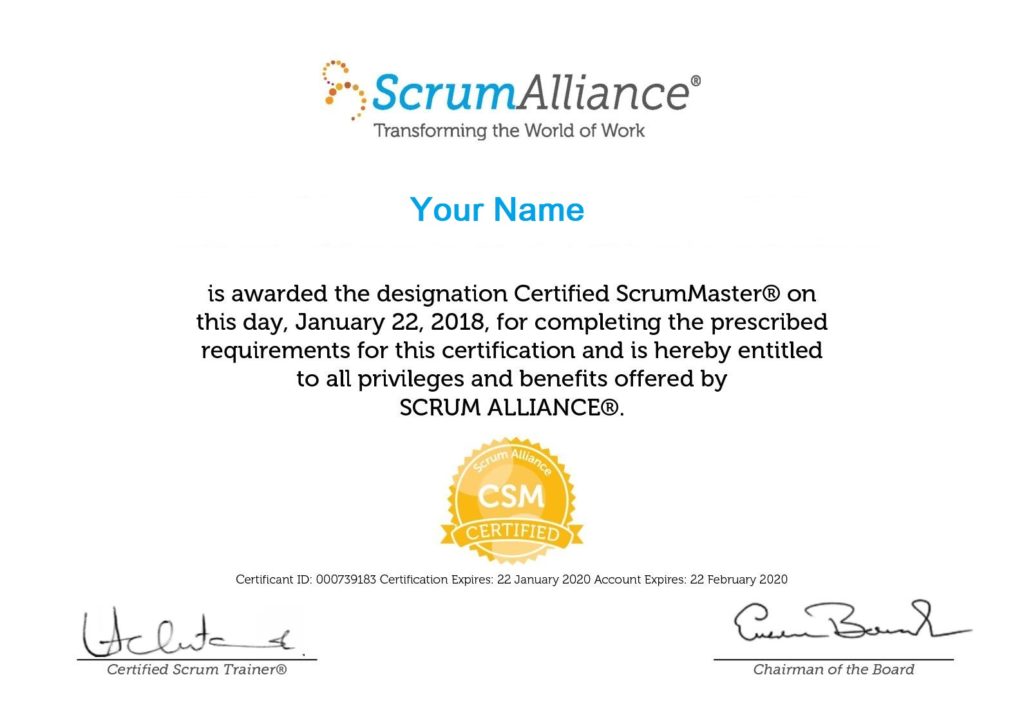
- Step 6 – Accept License & Download Certificate: Immediately after passing the test, accept the Scrum Alliance license agreement. You can then download your official Certified ScrumMaster (CSM) certificate and verified digital badge to showcase on LinkedIn and your resume.
How To Prepare For CSM Certification In Trivandrum Exam?
While the CSM certification exam is highly achievable, it is not something you can pass simply by relying on general project management knowledge. The exam tests a very specific framework, and answering questions based on "traditional business logic" rather than "Scrum logic" is a common pitfall for many professionals. A structured, focused preparation strategy during your CSM Certification Training in Trivandrum is essential to guarantee success on your first attempt.
The absolute cornerstone of your preparation must be the official Scrum Guide. Authored by the co-creators of Scrum, Ken Schwaber and Jeff Sutherland, this document is the definitive rulebook of the framework. Despite being relatively brief (about 13 pages), every single sentence is carefully chosen and carries significant weight. You must read the Scrum Guide multiple times until you deeply understand the strict boundaries of the three accountabilities (Scrum Master, Product Owner, Developers), the specific timeboxes of the five events, and the commitments attached to the three artifacts.
Active participation during the 2-day training workshop in Trivandrum is your next biggest advantage. Because the course is facilitated by a Certified Scrum Trainer (CST), the CSM curriculum is specifically designed to cover all the learning objectives defined by the Scrum Alliance exam format. Take exhaustive notes during the sessions, engage actively in the breakout room discussions, and do not hesitate to ask the trainer to clarify complex scenarios. The practical examples and analogies discussed in class are often the key to intuitively answering the tricky, scenario-based questions on the actual exam.
To build confidence, leverage mock exams and practice tests provided by EasyLearningTre. Taking practice tests under simulated exam conditions will help you identify knowledge gaps and get comfortable with the specific wording of the questions. Pay close attention to questions related to "Servant Leadership." A recurring theme in the exam is testing whether you would act as a dictator (incorrect) or a facilitator (correct) in a given situation. Remember: A Scrum Master does not assign tasks, dictate technical solutions to Developers, or overrule the Product Owner's backlog priorities; they coach, facilitate, and protect the process.
When you are ready to take the official exam, it is important to understand its structure. The test is administered online through the Scrum Alliance portal. It consists of 50 multiple-choice questions, and you are allotted 60 minutes to complete it. The passing threshold is 74%, meaning you need to answer at least 37 questions correctly. Because the exam is open-book, you are permitted to reference your notes and the Scrum Guide. However, time management is critical; if you attempt to look up every question, you will run out of time. Thorough preparation ensures you can answer the majority of questions intuitively, saving your reference materials for only the most difficult inquiries.
Mastering Agile Estimation, User Stories, and Scrum Metrics in CSM Training
One of the most practical segments of CSM Certification Training in Trivandrum focuses on how Scrum Teams translate high-level product visions and complex requirements into actionable, deliverable increments of value. Many teams struggle in the real world not because they misunderstand the rules of Scrum, but because they lack effective techniques for writing User Stories, estimating effort, and tracking progress empirically.
During our hands-on CSM Certification Training in Trivandrum, participants learn how to collaborate effectively with Product Owners and Developers to craft well-structured User Stories following the INVEST criteria (Independent, Negotiable, Valuable, Estimable, Small, and Testable). Instead of writing hundred-page requirement documents that nobody reads (and that become obsolete quickly), you learn how to frame backlog items from the end-user's perspective, complete with clear, testable Acceptance Criteria that align seamlessly with the team's overarching Definition of Done (DoD).
Furthermore, the course demystifies Agile Estimation and Release Planning. Traditional project management relies heavily on absolute time estimates (hours or days), which frequently fail in complex software environments due to unforeseen technical dependencies and knowledge work unpredictability. In CSM Certification Training in Trivandrum, you practice relative estimation techniques that empower Developers to forecast their capacity accurately and sustainably:
- Story Points & Modified Fibonacci Sequence: Learn how to estimate Product Backlog items based on complexity, uncertainty, and effort using nonlinear sequences like 1, 2, 3, 5, 8, 13, and 21 to avoid false precision.
- Planning Poker & Affinity Estimation: Practice collaborative, consensus-based estimation techniques that expose hidden technical assumptions and engage every Developer on the team equally.
- Team Velocity & Capacity Planning: Understand how to calculate average Sprint Velocity over time and use it ethically as an internal forecasting tool for Sprint Planning—never as a weapon to compare different teams or micromanage individuals.
- Sprint Burndown & Burnup Charts: Master visual radiators that track work remaining versus time elapsed, enabling the Scrum Team to inspect progress daily toward the Sprint Goal and adapt their Sprint Backlog proactively.
Why CSM Certification is Important for Professionals in Kerala?
In an intensely competitive job market like Kerala, where hard technical skills can become obsolete within a few years due to the rapid rise of AI and automation, frameworks that govern human collaboration, empathy, and organizational agility are more vital than ever. Enrolling in CSM Certification Training in Trivandrum is profoundly important for professionals because it represents a verified mastery of these enduring, human-centric leadership principles that machines cannot replace.
One of the critical reasons this certification holds such high value is that it establishes a standardized, global vocabulary. In many organizations, the term "Agile" is often misused as an excuse for chaotic, undocumented development without any structure. When you introduce a Certified Scrum Master into the environment, they bring strict, proven definitions. Everyone learns exactly what a "Sprint" is, what the "Definition of Done" entails, and why the "Daily Scrum" is a critical synchronization event for Developers, not a status update for management. This shared vocabulary eliminates ambiguity, aligns cross-functional teams, and drastically reduces the friction caused by miscommunication.
Furthermore, the CSM acts as an undeniable proof of competence to the outside world. It signals to prospective employers, stakeholders, and international clients that you have undergone rigorous, standardized training and are fully capable of driving an Agile transformation. It proves that you possess the emotional intelligence required to coach resistant team members, the strategic vision to assist Product Owners with complex backlogs, and the courage to shield your Developers from detrimental organizational politics and scope creep.
Beyond the immediate knowledge gained, achieving the CSM certification automatically integrates you into the Scrum Alliance global community. This professional network is an invaluable asset for long-term career growth. By being a member, you gain access to exclusive resources, webinars, global Scrum Gatherings, and local user groups. To maintain the certification, professionals are required to earn Scrum Education Units (SEUs) every two years. This built-in recertification process ensures that your knowledge remains fresh, relevant, and aligned with the latest industry best practices, making you a perpetually valuable asset to any forward-thinking organization.
How AI and Digital Transformation Are Elevating the Scrum Master Role in Trivandrum
As Artificial Intelligence (AI), generative coding assistants (like GitHub Copilot), and cloud automation rapidly reshape the global software industry, the role of the Scrum Master is evolving faster than ever. Forward-looking professionals enrolling in CSM Certification Training in Trivandrum often ask how AI impacts Agile delivery and whether Scrum Masters will be replaced. The reality is that while AI automates repetitive coding, testing, and documentation tasks, it significantly amplifies the complexity of product discovery, cross-team alignment, ethical decision-making, and human collaboration—areas where a Certified Scrum Master is absolutely irreplaceable.
Modern Scrum Masters in Trivandrum combine their foundational CSM knowledge with AI-powered Agile workflows to become high-impact productivity multipliers. By understanding the core principles taught in CSM Certification Training in Trivandrum, you can leverage modern digital tools without losing sight of core Agile values:
- Data-Driven Sprint Retrospectives: Use advanced project analytics from tools like Jira, Azure DevOps, and AI sentiment analyzers to spot workflow bottlenecks, cycle-time spikes, and recurring impediments before they completely derail a release schedule.
- Enhanced Backlog Refinement: Assist Product Owners in using AI tools to split large, ambiguous Epics into granular User Stories and generating comprehensive edge-case acceptance criteria faster during refinement workshops, saving valuable team time.
- Facilitating Hybrid & Distributed Teams: Utilize collaborative digital canvases such as Miro, Mural, and Confluence alongside structured Scrum facilitation techniques to keep remote teams in Trivandrum and across time zones deeply aligned and engaged.
- Protecting Human Creativity & Psychological Safety: As delivery speed increases dramatically through AI automation, the Scrum Master safeguards the team against cognitive overload and burnout, ensuring a sustainable pace and continuous human learning.
Challenges Faced By Scrum Masters in Traditional Work Environments
While the role of a Scrum Master is undoubtedly fulfilling, it is simultaneously one of the most psychologically and strategically demanding roles in modern business. Scrum Masters are tasked with changing human behavior and organizational culture—two things that are notoriously resistant to change. For Scrum Masters operating in Trivandrum's diverse corporate environment, which blends legacy enterprise mindsets with new-age tech, these challenges often manifest in several distinct ways.
The most pervasive challenge is organizational resistance and legacy management mindsets. Many companies want the benefits of Agile (speed, higher quality, adaptability) but are entirely unwilling to abandon the comforts of Waterfall (fixed scope, rigid deadlines, command-and-control management). A Scrum Master often finds themselves caught in the middle. They must constantly educate senior management on why they cannot have a traditional Gantt chart for a complex, unpredictable software project, and why they must trust the Developers to self-manage. Protecting the team from external stakeholders who try to inject new requirements in the middle of an active Sprint is a daily battle that requires immense tact, diplomacy, and courage.
Another frequent hurdle is the deep misunderstanding of the Scrum Master role itself. Because the role does not have a direct equivalent in traditional project management, organizations often try to mold the Scrum Master into a "Project Manager 2.0" or, conversely, a mere team secretary whose only function is to schedule Zoom links for the Daily Scrum and move tickets on Jira. A true Scrum Master must fiercely defend the integrity of their role, asserting their position as a coach, a facilitator, and an organizational change agent.
Dysfunctional team dynamics pose a significant internal threat. A Scrum Team might suffer from a lack of psychological safety, where Developers are afraid to speak up about technical debt or unachievable Sprint Goals for fear of reprimand. You might encounter dominant personalities who hijack the Sprint Retrospective, or passive members who refuse to collaborate cross-functionally. The Scrum Master must employ advanced conflict resolution, active coaching, and facilitation techniques to break down these silos and build a cohesive, highly motivated unit.
The Role of a Scrum Master in Remote and Hybrid Teams
In today's post-pandemic workspace, especially within IT hubs like Trivandrum where many professionals work in a hybrid model, the Scrum Master's role has expanded. Ensuring that remote Developers, a Product Owner working from home, and stakeholders in different time zones remain aligned requires deliberate effort and advanced facilitation skills. The physical Kanban board has been replaced by digital tools, but the need for human connection remains the same.
A critical part of CSM Certification Training in Trivandrum involves learning how to maintain high engagement during virtual Scrum Events. Scrum Masters learn to combat "Zoom fatigue" by making Sprint Planning and Retrospectives highly interactive. Using techniques like Liberating Structures, they ensure every voice is heard, not just the loudest person on the call. Furthermore, they help establish clear working agreements tailored to remote work, such as core collaboration hours, expected response times on Slack or Teams, and rules for asynchronous communication.
Scrum Renewal Process: How to Earn SEUs and Maintain Your CSM Certification
Your learning journey does not end once you pass the exam after CSM Certification Training in Trivandrum. To ensure that Certified ScrumMasters remain active practitioners with up-to-date skills, the Scrum Alliance requires CSM credentials to be renewed every two years. Fortunately, the renewal process is straightforward, highly rewarding, and designed specifically to support your continuous professional development.
To renew your CSM certification every two years, you need to accumulate 20 Scrum Education Units (SEUs) and submit a nominal renewal fee on the Scrum Alliance portal. One SEU is generally equivalent to one hour of active learning, reading, or community contribution related to Agile and Scrum. Notice that when you complete your initial 2-day CSM Certification Training in Trivandrum with EasyLearningTre, you immediately receive 20 PDUs and 20 SEUs, giving you a strong foundational understanding of how continuing education credits work.
- Attending Webinars & Agile Conferences: Participate in Scrum Alliance Regional Gatherings, local Agile meetups in Trivandrum, or live virtual webinars hosted by Agile thought leaders to earn SEUs easily.
- Self-Directed Learning: Read authoritative books on Scrum, Agile coaching, Servant Leadership, and product management, or watch educational courses on the Scrum Alliance resource library and document your learning.
- Volunteering & Community Contribution: Write articles or blogs on Agile best practices, mentor junior team members transitioning to Agile, or present case studies at corporate knowledge-sharing sessions.
- Pursuing Next-Level Scrum Alliance Certifications: Earning an additional Scrum Alliance certification—such as CSPO (Certified Scrum Product Owner) or A-CSM (Advanced Certified ScrumMaster)—automatically renews your existing CSM certification for another two years without requiring separate SEU submissions.
Top Scrum Master Interview Scenarios & Career Readiness for Trivandrum Professionals
Securing a high-paying Scrum Master or Agile Coach position requires more than just listing a certification on your resume; you must demonstrate practical situational judgment during interviews. Hiring managers in Trivandrum and across top MNCs rarely ask textbook definitions like "What is the duration of a Sprint?". Instead, they present real-world team dysfunctions and ask how you, as a Certified ScrumMaster, would resolve them. Our CSM Certification Training in Trivandrum prepares you to tackle these behavioral and scenario-based interview questions with absolute confidence.
During the 2-day interactive workshop, our Certified Scrum Trainers walk you through real corporate case studies that closely mirror the exact questions asked in technical and managerial interviews:
- Handling Mid-Sprint Scope Creep: How to effectively coach the Product Owner and senior stakeholders when urgent new requirements are pushed onto Developers in the middle of an active Sprint, and determining when a Sprint cancellation is (or is not) justified.
- Dealing with Disengaged Daily Scrums: Proven techniques to transform monotonous "status report" standups back into energized, 15-minute Developer-led planning and synchronization huddles strictly focused on the Sprint Goal.
- Coaching an Absent or Overwhelmed Product Owner: Actionable strategies to support a Product Owner who lacks time for Backlog Refinement, which typically results in poorly defined stories and stalled Sprint Planning sessions.
- Managing Spillover Work & Incomplete Increments: How to handle unfinished Sprint Backlog items at the end of a Sprint empirically—avoiding a culture of blame while inspecting root causes during the Sprint Retrospective and correctly re-estimating items on the Product Backlog.
- Resolving Conflict Within Cross-Functional Teams: Practical coaching frameworks to mediate severe disagreements between senior engineers, QA testers, and UX designers while preserving team autonomy and psychological safety.
By mastering both the strict theoretical rigor of the Scrum Guide and these hands-on practical scenarios through CSM Certification Training in Trivandrum at EasyLearningTre, you graduate ready to pass the CSM exam on your first attempt and confidently lead high-performing Agile teams from day one.
Understanding Agile Scaling (SAFe, LeSS) post CSM Certification
Once you have established a strong foundation with the CSM Certification Training in Trivandrum, you may find yourself working in large enterprises where multiple Scrum Teams need to collaborate on a single, massive product. This is where scaling frameworks come into play. While Scrum works perfectly for single teams, frameworks like the Scaled Agile Framework (SAFe) or Large-Scale Scrum (LeSS) provide patterns for scaling these practices across hundreds of practitioners.
A Certified ScrumMaster is perfectly positioned to step into scaling roles, such as a Scrum Master for an Agile Release Train (ART) in SAFe. Understanding the core principles of Scrum ensures that when you scale, you are scaling empirical process control and Agile values, rather than just adding bureaucratic layers. Your CSM certification proves you understand the foundational building blocks required before an organization can successfully scale its Agile practices.
Tips For Long-Term Success In a Scrum Career
Earning your credential through CSM Certification Training in Trivandrum is just the starting line of a lifelong journey in Agile mastery. To truly excel and build a sustainable, high-impact career as a Scrum Master, you must continually refine both your technical understanding of the framework and, more importantly, your interpersonal soft skills. The best Scrum Masters are not enforcers of rules, but enablers of people.
First and foremost, you must deeply internalize and embody Servant Leadership. Your success is no longer measured by the code you write or the features you personally design; it is measured entirely by the health, efficiency, and autonomy of your team. You must genuinely care about removing their impediments, protecting their focus, and helping them grow as professionals. When the team fails, you must shoulder the responsibility of analyzing the system flaws; when the team succeeds, you must step back and let them take the credit. This lack of ego is the true hallmark of an elite Scrum Master.
Secondly, cultivate radical empathy and active listening. A great Scrum Master spends 80% of their time listening and observing, and only 20% speaking. You need to develop a high degree of emotional intelligence to understand the intense pressures faced by the Product Owner from the market, the anxieties of the Developers regarding technical complexity, and the overarching goals of the business stakeholders. By establishing unwavering trust and psychological safety, you create an environment where radical transparency can thrive, allowing the team to inspect and adapt genuinely during Sprint Retrospectives.
Third, become a master of facilitation. Facilitation is an art. Whether you are guiding a chaotic Sprint Planning session or mediating a heated disagreement over a technical architectural approach, your ability to keep the conversation focused, timeboxed, and productive is critical. Invest time in learning various facilitation frameworks, brainstorming techniques, and decision-making models (like dot-voting or the fist of five) to keep Scrum events highly engaging, inclusive, and valuable.
Finally, commit to a path of continuous learning and advanced certification. The Agile landscape is constantly shifting, with new scaling frameworks and complementary practices (like Kanban or DevOps) emerging regularly. Do not stagnate. Gather your SEUs by attending local Agile meetups in Trivandrum, reading industry-leading books, and contributing back to the community. As you gain practical experience, set your sights on higher-level credentials such as the Advanced Certified ScrumMaster (A-CSM) or the Certified Scrum Professional-ScrumMaster (CSP-SM). These advanced certifications validate your ability to handle complex organizational transformations and place you securely in the highest echelons of Agile leadership worldwide.