The Ultimate Guide to Scrum Mastery in India's Silicon Valley
Accelerate your career trajectory with deep insights into CSM Certification Training in Bangalore, exclusive IT ecosystem dynamics, and high-impact strategies to lead Elite Agile teams in the tech capital.
India's IT Capital: Why Bangalore Demands Elite Agile Leaders
Bangalore is universally recognized as the Silicon Valley of India, operating at a velocity and scale that is virtually unmatched anywhere else in the country. From the massive legacy IT service parks in Electronic City to the ultra-modern innovation hubs scattered across Whitefield and the Outer Ring Road (ORR), the city is the central nervous system of global software development. In this hyper-competitive, fast-evolving ecosystem, relying on archaic, highly predictive project management methodologies like Waterfall is no longer just inefficient—it is corporate suicide. The absolute demand for continuous deployment, rapid market pivoting, and relentless customer feedback has made Agile frameworks the default operating system for businesses here. Consequently, undergoing CSM Certification Training in Bangalore has become one of the most vital career investments for any tech professional looking to survive and thrive.
However, claiming to "be Agile" and actually executing complex software delivery are two entirely different things. This is exactly where the Scrum Alliance’s Certified ScrumMaster (CSM) credential proves its immense worth. Unlike self-paced certifications that simply test your ability to memorize a PDF, the CSM mandates 16 hours of highly interactive, live instruction. Facilitated exclusively by world-class Certified Scrum Trainers (CSTs), this immersive workshop forces you to step away from theoretical definitions and practice real-world, tactical Scrum execution. You learn how to take massive, multi-million dollar initiatives and break them down into highly predictable, two-to-four-week Sprints.
By securing your CSM Certification Training in Bangalore, you are actively proving to the thousands of recruiters operating in the city that you possess the advanced emotional intelligence, empirical forecasting capabilities, and technical facilitation skills required to lead. You transition from a traditional "task allocator" to a highly respected Servant Leader who can dismantle bureaucratic roadblocks, shield developers from toxic stakeholder pressure, and guarantee the continuous delivery of high-value software products.
Driving Hyper-Growth: The Unicorn Startup Ecosystem in Koramangala & HSR Layout
While massive IT parks dominate the outskirts of the city, the true heartbeat of Bangalore's innovation lies in neighborhoods like Koramangala, Indiranagar, and HSR Layout. This region is the undisputed startup and "Unicorn" capital of India, housing revolutionary companies in FinTech, EdTech, AgriTech, and E-commerce. For these hyper-growth startups, time is literally survival. Running out of venture capital runway before finding true Product-Market Fit is the ultimate risk. CSM Certification Training in Bangalore equips aspiring founders and startup leaders with the exact tactical framework to mitigate this financial risk aggressively.
- The Power of the MVP: Scrum forces startups to stop building massive, secretive platforms over a year-long period. Instead, it mandates the creation of a Minimum Viable Product (MVP) released in short Sprints, allowing founders to pivot based on real user feedback before funds run dry.
- Navigating Rapid Scaling: As startups suddenly grow from 10 employees to 200, chaos naturally ensues. Certified Scrum Masters introduce structured cadences (like the Daily Scrum and Sprint Planning) to maintain alignment and sanity during explosive hiring phases without stifling startup culture.
- Protecting Engineering Culture: In startups, developers are often forced to work brutal 80-hour weeks. The Scrum Master steps in to enforce sustainable pace, ensuring that the team only commits to what their historical Velocity proves they can handle, severely reducing costly developer burnout.
By mastering these empirical techniques, a CSM working in the startup sector becomes an invaluable strategic partner to the CEO, ensuring the company iterates faster than its competitors while maintaining a healthy, high-performing engineering culture.
The Scrum Master as a Systems Thinker in Massive Global Capability Centers (GCCs)
Beyond the startup ecosystem, Bangalore hosts the largest concentration of Global Capability Centers (GCCs) in the world. Massive international banks, global retailers, and Fortune 500 manufacturing giants have established immense captive engineering units along the Outer Ring Road (ORR) and Manyata Tech Park. Working in these massive corporate environments presents a totally different set of challenges. Teams in Bangalore must remain perfectly synchronized with product visions dictated by headquarters in Silicon Valley, London, or Tokyo, often dealing with extreme time zone differences and heavy corporate bureaucracy. CSM Certification Training in Bangalore provides the exact framework needed to navigate this scale.
A critical part of your training involves learning how to operate as a "Systems Thinker." In a massive GCC, local optimizations (making one team slightly faster) are useless if the overall system (security, compliance, integration) is incredibly slow. As a Certified Scrum Master, you will learn to identify these systemic bottlenecks. If your development team can code a feature in two weeks, but it takes six weeks for the global compliance team to approve the release, you are not truly Agile. The CSM must courageously step outside the boundaries of the immediate development team and coach the broader organization, advocating for automated testing and CI/CD pipelines to ensure the Definition of Done (DoD) actually results in a releasable increment.
Furthermore, you will learn advanced facilitation for distributed teams. You will master the use of collaborative digital canvases (like Miro and Mural) to run highly engaging, asynchronous Sprint Plannings and Retrospectives, ensuring that the Bangalore teams are viewed as high-value innovation partners rather than just a low-cost offshore execution arm.
Decoding the Scrum Events: From Whitefield Boardrooms to Distributed Sprints
At the core of the Scrum framework is the concept of cadence—a rhythmic, highly predictable heartbeat that keeps the team aligned, motivated, and moving forward. This heartbeat is the Sprint, a fixed timebox (usually two to four weeks) during which a "Done," usable, and potentially releasable product Increment is created. A major component of CSM Certification Training in Bangalore is taking a deep, tactical dive into the mechanics of the Sprint and the four critical ceremonies that occur within it.
- Sprint Planning (The Alignment): The Scrum Team collaborates to determine the Sprint Goal (Why is this valuable?), pull items from the Product Backlog (What can be done?), and formulate an actionable plan (How will we do it?). The Scrum Master ensures this event is heavily collaborative and prevents management from forcing arbitrary deadlines onto the Developers.
- The Daily Scrum (The Micro-Correction): A strict 15-minute timebox designed exclusively for the Developers. It is not a status update to the Scrum Master. It is a daily synchronization point where Developers inspect their progress toward the Sprint Goal and adapt their plan for the next 24 hours. The CSM ensures this remains focused and highly technical.
- Sprint Review (The Demonstration of Value): Held at the end of the Sprint, this is a working session with stakeholders to inspect the newly built Increment. It is not a polished, fake PowerPoint presentation; it is an open discussion about what was built, changes in the market, and what to do next. Transparency here is absolutely paramount.
- Sprint Retrospective (Continuous Kaizen): The final event of the Sprint. The team looks inward to inspect their own interactions, processes, and tools. The Scrum Master facilitates this session to ensure it remains a safe, blame-free environment where the team can identify actionable improvements for the next Sprint.
Scrum Metrics: Protecting Teams from the "Velocity Trap"
One of the most dangerous dysfunctions occurring in Bangalore's massive IT service firms is the weaponization of Agile metrics. Traditional management, desperate for predictable control, often attempts to measure Agile teams using legacy KPIs, or worse, they weaponize "Velocity." Velocity is simply a historical average of the amount of work (usually measured in Story Points) a specific team can complete in a Sprint. It is a highly localized capacity forecasting tool. However, when management attempts to use velocity to compare Team A against Team B, or demands that velocity arbitrarily increase by 10% every Sprint, it inevitably leads to points-inflation, severely reduced software quality, and destroyed morale. CSM Certification Training in Bangalore teaches you how to combat this actively.
As a Certified Scrum Master, you must educate your organization to look beyond these vanity metrics and focus on indicators that actually measure the flow of value. You will learn to champion metrics such as Lead Time (the total time elapsed from the moment a customer request is made until it is delivered) and Cycle Time (the time it takes for a team to actually work on and complete a backlog item). Reducing cycle time through the removal of organizational impediments is a far better indicator of a team's true agility than artificially inflating their velocity.
Furthermore, you will focus heavily on tracking the delivery of actual Business Value. Are the features the team is delivering actually being used by the customers? Is the software stable, as indicated by a low defect escape rate? By shifting the organization's focus from tracking "busyness" to tracking outcomes and value, you ensure that the Scrum framework is being used to build the right products, not just build products faster.
CSM vs. Traditional PMP: The Paradigm Shift in Karnataka's Tech Sector
Given India's deep history in heavy engineering and construction, the Project Management Professional (PMP) certification has historically been highly sought after. However, as software completely eats the world, IT professionals in Bangalore frequently ask: "Should I pursue traditional project management or an Agile certification?" Understanding this massive paradigm shift is a core component of deciding to enroll in CSM Certification Training in Bangalore.
The PMP is deeply rooted in predictive, sequential project management (Waterfall). It is absolutely the correct certification if you are building the Namma Metro in Bangalore—you know the materials, the physics, and the exact end goal before you start, and changing the design halfway through is physically impossible. However, if you are building a consumer tech application, where requirements change daily based on user feedback and technological shifts, predictive planning is a massive liability.
- Adaptability over Rigid Planning: CSM teaches you how to pivot rapidly based on real market feedback at the end of every Sprint, whereas traditional management actively penalizes "scope creep."
- Empowered Teams over Micromanagement: PMP traditionally positions the Project Manager as the central node of control who assigns tasks. Scrum distributes this power, allowing Developers to self-manage their daily technical execution, leading to vastly higher innovation.
- Time to Certification: PMP requires thousands of hours of documented experience before attempting a grueling exam. The CSM is highly accessible to anyone willing to undergo the rigorous 2-day live training, making it perfect for professionals looking to pivot their careers immediately.
For software engineers, QA leads, and digital product managers operating in Bangalore, the CSM is undeniably the more relevant, highly demanded, and future-proof credential.
Step-by-Step Roadmap to Achieving Your CSM Credential in Bangalore
At EasyLearningTre, we have completely optimized the certification journey to ensure that busy professionals—navigating Bangalore's notorious traffic and demanding corporate hours—can achieve their goals over a single weekend. Here is the exact, stress-free roadmap you will follow to secure your globally recognized credential through our CSM Certification Training in Bangalore:
- Step 1 – Secure Your Seat: Review the upcoming weekend or weekday batches on our Bangalore training calendar and complete a fast, secure online enrollment from your home or office.
- Step 2 – Begin Pre-Learning: You will immediately receive access to the official Scrum Guide and proprietary EasyLearningTre study materials to help you internalize the vocabulary before the live class.
- Step 3 – The 2-Day Immersive Workshop: Log into the live virtual classroom for 16 hours of high-energy, interactive training with a globally acclaimed CST. Participate in group breakout sessions and real-world corporate simulations.
- Step 4 – Profile Activation: Once the workshop concludes, your CST will validate your attendance with the Scrum Alliance, generating a welcome email that allows you to activate your official profile.
- Step 5 – Ace the Online Exam: Take the 50-question, multiple-choice exam online at your convenience. With 60 minutes on the clock and two free attempts provided within 90 days, passing the 74% mark is highly attainable.
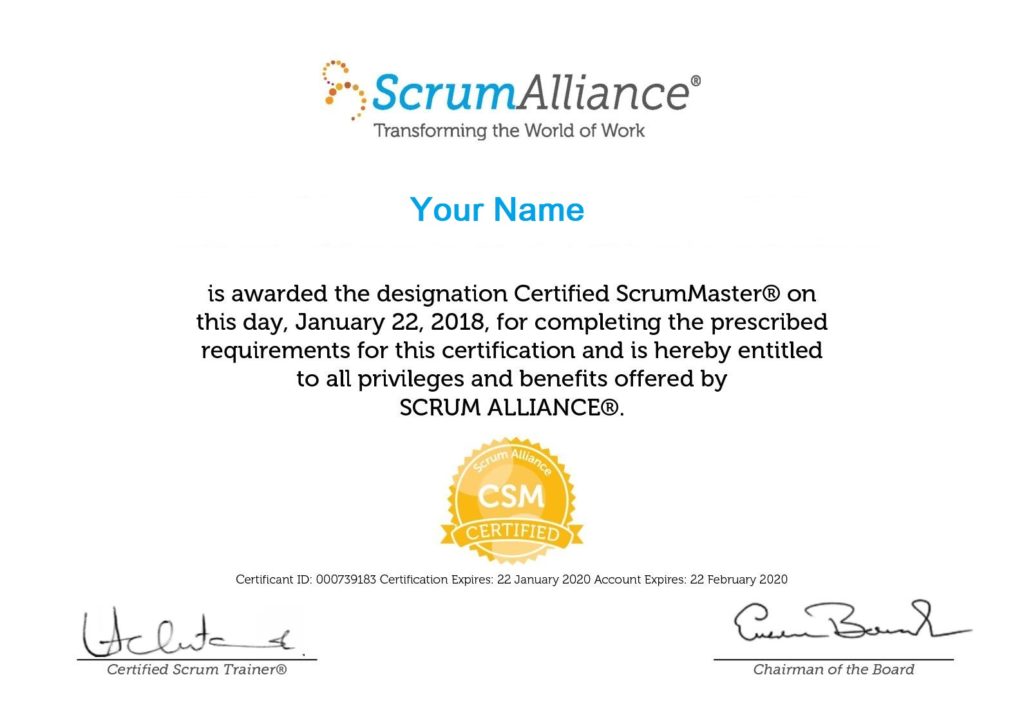
- Step 6 – Claim Your Credential: Accept the license agreement on the Scrum Alliance dashboard to instantly download your CSM certificate and secure your verifiable digital badge to showcase on LinkedIn.
Agile Contracting and Vendor Management in Bangalore's IT Services
Bangalore is home to the headquarters and massive campuses of India's largest IT service providers and consultancies (like Infosys, Wipro, and massive divisions of TCS). These organizations build complex software for global clients. A major challenge these firms face is that traditional client contracts are written for Waterfall: "We will pay you X amount of dollars for exactly Y features delivered on Z date." Because software development is highly complex and unpredictable, these fixed-price, fixed-scope contracts almost always result in bitter disputes, massive missed deadlines, and compromised code quality. CSM Certification Training in Bangalore provides critical insights into shifting toward true Agile contracting.
A Certified Scrum Master working in an IT services firm must help bridge the gap between the client's rigid procurement department and the agile development team. You will learn the mechanics of "Time and Materials" contracts or "Agile Fixed Price" agreements, where the budget and timeline are fixed, but the scope remains highly flexible and ordered strictly by business value. By leveraging the extreme transparency of the Sprint Review—where the offshore client sees working, tested software every two weeks—the CSM builds immense trust. When clients see continuous, high-quality delivery, they naturally abandon their need for predictive Gantt charts and embrace the empirical flexibility that Scrum provides.
Sustaining Excellence: Earning SEUs in the Bangalore Agile Community
Your journey of learning does not stop once you pass the exam after your CSM Certification Training in Bangalore. To ensure that the global pool of Certified ScrumMasters remains active, educated, and completely up-to-date with shifting tech industry trends, the Scrum Alliance requires you to renew your credential every two years. This process is designed to be highly rewarding and focuses entirely on your continuous professional development.
To renew the certification, you must accumulate 20 Scrum Education Units (SEUs) over the two-year period and pay a nominal renewal fee via the Scrum Alliance portal. Generally, one SEU equals one hour of active learning, reading, or giving back to the Agile community. Conveniently, by completing your initial 2-day CSM Certification Training in Bangalore with EasyLearningTre, you automatically earn 20 PDUs and 20 SEUs, giving you a perfect understanding of how these continuing education credits function.
- Community Engagement: Bangalore boasts the most vibrant Agile community in India. Earn SEUs by attending live meetups organized by Agile Network India (ANI) chapters across the city, participating in Unconferences, or joining global Regional Gatherings virtually.
- Self-Directed Study: You can earn SEUs by reading highly recommended books on Scrum, Agile coaching, or product management, and watching educational content in the Scrum Alliance resource library.
- Community Contribution: Volunteering, writing articles or blogs on Agile best practices, mentoring junior colleagues, or presenting case studies at your workplace all count towards your SEUs.
- Advancing Your Certifications: Earning a next-level Scrum Alliance credential, such as the CSPO (Certified Scrum Product Owner) or the A-CSM (Advanced Certified ScrumMaster), automatically renews your foundational CSM certification for another two years.
Cracking Scrum Master Interviews in Bangalore's Top Tech Firms
Securing your CSM certification is a massive milestone, but landing a premium, high-paying role at a top Bangalore MNC requires you to demonstrate situational intelligence during grueling interviews. Hiring managers at companies like Amazon, Flipkart, Microsoft, and massive GCCs will rarely ask you to recite textbook definitions. Instead, they will present you with complex team dysfunctions and ask how you, as a Certified ScrumMaster, would resolve them. Our CSM Certification Training in Bangalore is specifically designed to prepare you for these intense scenario-based evaluations.
During the workshop, your CST will guide you through authentic corporate case studies that mirror the exact questions asked by elite hiring managers:
- Handling Scope Creep Mid-Sprint: Formulating exact strategies on how to respectfully push back on a senior VP who tries to add urgent requirements into an active Sprint, and determining when a Sprint cancellation is actually justified.
- Reviving Zombie Daily Scrums: Proven, actionable techniques to transform monotonous "status update" meetings back into energized, 15-minute synchronization huddles owned entirely by the Developers.
- Coaching an Overwhelmed Product Owner: Learning how to support a Product Owner who lacks time for Backlog Refinement, which typically leads to vague User Stories and disastrous Sprint Planning sessions.
- Resolving Cross-Functional Conflict: Implementing advanced coaching frameworks to mediate severe technical disagreements between senior developers and QA testers while preserving team autonomy and psychological safety.
By mastering the strict rules of the Scrum Guide and understanding how to apply them to these complex human scenarios via CSM Certification Training in Bangalore, you graduate fully prepared to ace tough interviews and lead high-performing Agile teams from day one in India's most competitive tech ecosystem.