The Ultimate Guide to Scrum Mastery in Patna
Elevate your leadership capabilities with deep insights into CSM Certification Training in Patna, career opportunities, and proven strategies to drive business agility in Bihar's evolving tech landscape.
The Digital Resurgence in Patna and the Need for Agile Leaders
Historically recognized for its administrative, educational, and agricultural prominence, Patna is currently undergoing a massive digital resurgence. With the proactive establishment of government initiatives like the Bihar Startup Policy, incubation centers at top institutes, and the expansion of IT zones near Beltron Bhawan and Patliputra Industrial Area, the city is rapidly transitioning into an emerging technology hub. However, as local startups scale and established enterprises modernize their operations, they are encountering a significant roadblock: traditional, top-down project management methods are simply too slow for the modern digital economy. This is where the absolute necessity for Agile leaders arises, making CSM Certification Training in Patna a highly strategic career choice.
The global standard for executing Agile is the Scrum framework. By enrolling in CSM Certification Training in Patna, professionals position themselves at the very center of this regional transformation. The Scrum Alliance’s CSM credential is not just another theoretical degree; it requires participants to undergo 16 hours of intensive, live instruction delivered by a Certified Scrum Trainer (CST). During this interactive workshop, candidates step away from rigid Waterfall concepts—like fixed requirements and massive upfront planning—and learn how to manage complex, highly unpredictable projects using short, iterative cycles known as Sprints.
Through this experiential learning, participants in Patna master the core mechanics of empirical process control. You will understand how to foster extreme Transparency within a team, establish cadences for frequent Inspection, and build a culture where Adaptation is embraced rather than feared. For professionals in Bihar looking to secure high-impact roles in local tech firms, e-governance initiatives, or highly lucrative remote positions with global MNCs, the CSM credential acts as undeniable proof that you possess the advanced facilitation and leadership skills necessary to drive modern software development.
Decoding the Scrum Master's True Purpose: Beyond a Project Manager
One of the most critical lessons taught during CSM Certification Training in Patna is understanding what a Scrum Master actually is—and more importantly, what they are not. In traditional corporate environments in Bihar, the concept of a "Project Manager" is deeply ingrained. A Project Manager typically assigns tasks, tracks individual hours, updates Gantt charts, and holds people accountable for deadlines. A Scrum Master does none of these things. In fact, attempting to act like a traditional manager while using the title of Scrum Master will immediately sabotage a Scrum adoption.
A Scrum Master is defined by the Scrum Guide as a true "Servant Leader." Your primary responsibility is not to manage the people, but to manage the Scrum process. When you undergo CSM Certification Training in Patna, you learn that your true purpose is to act as a coach and a mirror for the organization. If the Developers are struggling to meet their Sprint Goal because they are constantly interrupted by outside stakeholders, the Scrum Master steps in to protect them. If the Product Owner is struggling to prioritize the Product Backlog, the Scrum Master provides them with the right tools and techniques to maximize value delivery.
Furthermore, the Scrum Master operates without formal authority over the team. You cannot hire, fire, or dictate technical solutions. Instead, you lead entirely through influence, empathy, and an unshakable understanding of the Agile values. This requires a profound psychological shift. During your training, you will participate in role-playing exercises that teach you how to ask powerful, open-ended questions that lead teams to discover their own solutions, rather than simply telling them what to do. This cultivation of self-managing teams is the ultimate sign of a masterful Scrum practitioner.
How CSM Certification in Patna Drives Enterprise Agility?
Many professionals assume that Scrum is only applicable to software development teams. While it originated in the software industry, the principles learned during CSM Certification Training in Patna are now being aggressively adopted by marketing, HR, education, and manufacturing sectors. This broader organizational adoption is known as Enterprise Agility, and Certified ScrumMasters are the architects driving this shift across Bihar's diverse business landscape.
- Reducing Waste and Time-to-Market: Traditional businesses often spend months in the planning and documentation phases before any actual value is created. Scrum forces organizations to deliver a "Done," usable increment within 30 days or less. This drastically reduces the financial risk of building the wrong product.
- Enhancing Customer Collaboration: Instead of relying on a contract negotiated a year ago, Scrum incorporates the customer (or stakeholders) directly into the process via the Sprint Review. This ensures that the product being built actually solves the customer's current problems, which may have changed since the project began.
- Breaking Down Corporate Silos: In many older enterprises in Patna, departments work in extreme isolation (e.g., design hands off to development, development hands off to testing). Scrum eliminates this by mandating cross-functional teams, where all the skills necessary to create value exist within one cohesive, self-managing unit.
- Continuous Improvement (Kaizen): Through the Sprint Retrospective, the Scrum Master ensures that the team has a dedicated timebox to inspect their own behaviors, tools, and relationships. This guarantees that the enterprise is getting slightly better, faster, and more efficient with every single iteration.
By bringing these powerful enterprise agility concepts to local companies, a CSM professional becomes an invaluable asset capable of transforming stagnant corporate cultures into highly dynamic, market-responsive engines.
The Anatomy of a High-Performing Scrum Team
A significant portion of your CSM Certification Training in Patna focuses on the exact composition and accountabilities of the Scrum Team. Unlike traditional structures that feature complex hierarchies of junior devs, senior leads, tech managers, and QA directors, Scrum intentionally flattens the structure. A Scrum Team consists of exactly three accountabilities: The Scrum Master, the Product Owner, and the Developers. There are no sub-teams and no hierarchies within a Scrum Team. It is a cohesive unit of professionals focused entirely on one objective at a time: the Product Goal.
The Product Owner is the sole person accountable for maximizing the value of the product resulting from the work of the Scrum Team. They achieve this by clearly expressing Product Backlog items, ordering them based on business value, and ensuring that the backlog is perfectly transparent to everyone. They are the voice of the customer and the ultimate decision-maker regarding *what* needs to be built.
The Developers are the individuals committed to creating any aspect of a usable Increment each Sprint. Crucially, in Scrum, the term "Developer" applies to anyone contributing to the creation of the increment—whether they are a programmer, a tester, a UI/UX designer, or a technical writer. The Developers are fiercely protected by the Scrum Master, and they have absolute autonomy over *how* to build the items selected from the Product Backlog. No one, not even the Scrum Master or CEO, tells the Developers how to turn Product Backlog items into Increments of value.
A Deep Dive into Scrum Events: Maximizing Transparency in Remote Teams
For many IT professionals based in Patna, the post-pandemic world has opened up incredible opportunities to work remotely for companies based in the US, Europe, or major Indian metros like Bangalore and Hyderabad. However, managing and facilitating distributed remote teams presents unique challenges. CSM Certification Training in Patna equips you with the exact tactical knowledge to run the five official Scrum Events effectively, even when the team is spread across multiple time zones.
Scrum establishes five formal events, all of which are strictly timeboxed to prevent Parkinson's Law (where work expands to fill the time allotted for it). The overarching event is the Sprint itself, a container for all other events. Inside the Sprint, the team executes:
- Sprint Planning: This event initiates the Sprint by laying out the work to be performed. The entire team collaborates to answer three questions: Why is this Sprint valuable (The Sprint Goal)? What can be Done this Sprint? And How will the chosen work get done? In remote settings, CSMs use digital whiteboards to ensure everyone is actively participating.
- Daily Scrum: A 15-minute event specifically for the Developers. It is not a status update to the Scrum Master. It is a daily synchronization meeting where Developers inspect their progress toward the Sprint Goal and adapt their Sprint Backlog accordingly. Remote Scrum Masters must coach teams to keep this highly focused and prevent it from turning into a one-hour technical debate.
- Sprint Review: Held at the end of the Sprint, this is where the Scrum Team and external stakeholders inspect the outcome of the Sprint (the Increment) and determine future adaptations. It is a collaborative working session, not a formal PowerPoint presentation.
- Sprint Retrospective: The concluding event of the Sprint. The team inspects how the last Sprint went with regards to individuals, interactions, processes, tools, and their Definition of Done. The Scrum Master's role here is critical in fostering a blame-free remote environment where actual process improvements can be discussed honestly.
Overcoming Common Agile Implementation Hurdles in Traditional Industries
As professionals complete their CSM Certification Training in Patna and return to their workplaces, they often encounter a harsh reality: organizational resistance. Implementing Scrum is easy on paper but incredibly difficult in practice, largely because it exposes all the hidden dysfunctions within a company. A Certified ScrumMaster is essentially a change agent, and change is uncomfortable for those accustomed to traditional power structures.
One of the most common hurdles is the "Agile in Name Only" syndrome. This happens when a company renames its Project Managers to Scrum Masters, renames its phases to Sprints, but changes absolutely nothing about how power is distributed. Management still demands fixed-scope, fixed-date delivery guarantees. The Scrum Master must employ immense tact to slowly educate stakeholders on why empirical forecasting is more accurate than predictive forecasting in complex domains.
Another massive hurdle is technical debt and a lack of engineering maturity. A Scrum team cannot deliver a "Done," shippable increment every two weeks if it takes them three weeks just to manually test their code and deploy it to a staging server. While the Scrum Master is not necessarily a technical programmer, they must aggressively advocate for the adoption of Extreme Programming (XP) practices—like Test-Driven Development (TDD), automated testing, and Continuous Integration/Continuous Deployment (CI/CD) pipelines—to ensure the mechanics of Scrum can actually be supported by the company's infrastructure.
CSM vs Other Credentials: Why Scrum Alliance Stands Out
When deciding to pursue Agile training in Patna, you will inevitably compare the Certified ScrumMaster (CSM) from the Scrum Alliance against the Professional Scrum Master (PSM) from Scrum.org or the PMI-ACP. The reason CSM Certification Training in Patna remains the overwhelming favorite among hiring managers globally comes down to its strict educational standards and emphasis on human interaction.
The PSM exam can be taken simply by paying a fee and passing an online test, meaning a candidate could theoretically pass it without ever having spoken to another human being about Agile principles. Conversely, the Scrum Alliance recognizes that a Scrum Master's entire job revolves around facilitation, empathy, and navigating human conflict. Therefore, you cannot simply buy the CSM certification; you must earn it by actively participating in 16 hours of live, CST-led training. This ensures that when a company in Patna hires a CSM, they are hiring someone who has practiced the ceremonies, debated the nuances of the Scrum Guide, and role-played conflict resolution.
Furthermore, the Scrum Alliance provides an unparalleled global community. Once certified, you gain a two-year membership that unlocks access to exclusive regional gatherings, local user groups, and continuous learning resources. This is not just a certification; it is a gateway into a global network of top-tier Agile professionals, giving you a massive advantage in your long-term career progression.
Step-by-Step Guide to Achieving CSM in Patna
At EasyLearningTre, we have engineered the certification journey to be as seamless and impactful as possible for busy working professionals. Here is the exact roadmap you will follow to secure your globally recognized credential through our CSM Certification Training in Patna:
- Step 1 – Secure Your Seat: Review the upcoming weekend or weekday batches on our Patna training calendar and complete a fast, secure online enrollment.
- Step 2 – Begin Pre-Learning: You will immediately receive access to the official Scrum Guide and proprietary EasyLearningTre study materials to help you internalize the vocabulary before the live class.
- Step 3 – The 2-Day Immersive Workshop: Log into the live virtual classroom for 16 hours of high-energy, interactive training with a globally acclaimed CST. Participate in group breakout sessions and real-world simulations.
- Step 4 – Profile Activation: Once the workshop concludes, your CST will validate your attendance with the Scrum Alliance, generating a welcome email that allows you to activate your official profile.
- Step 5 – Ace the Online Exam: Take the 50-question, open-book exam online at your convenience. With 60 minutes on the clock and two free attempts provided within 90 days, passing the 74% mark is highly attainable.
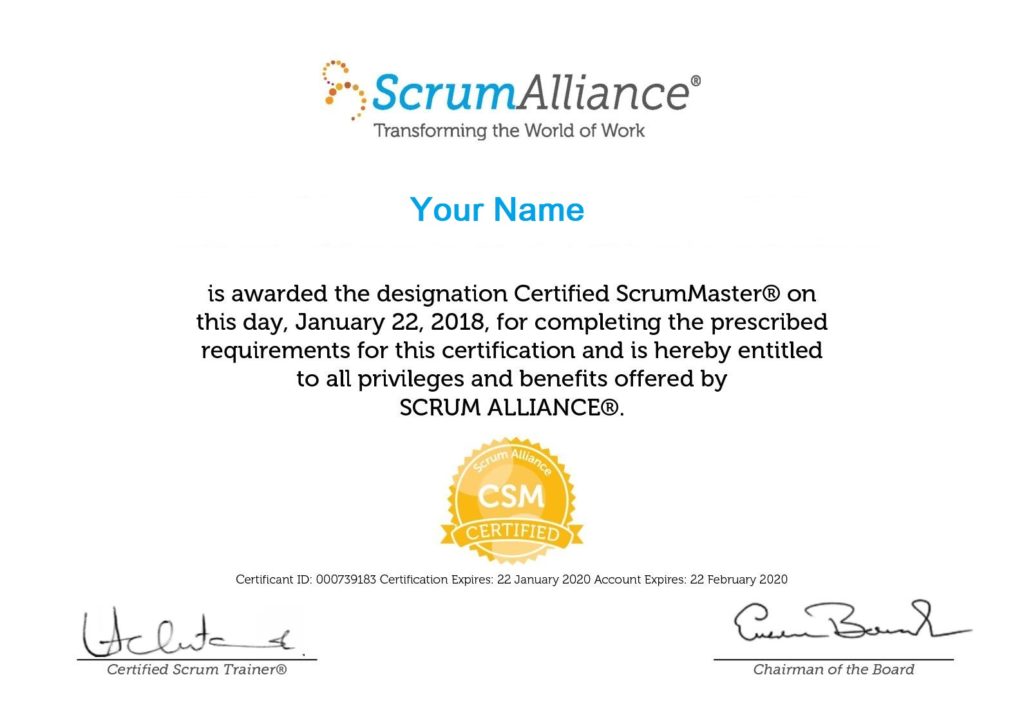
- Step 6 – Claim Your Credential: Accept the license agreement on the Scrum Alliance dashboard to instantly download your CSM certificate and secure your verifiable digital badge for LinkedIn.
Building a Sustainable Agile Career: From CSM to Enterprise Coach
Your journey does not end with CSM Certification Training in Patna; it is merely the launchpad. The Agile career trajectory is highly lucrative and offers incredible vertical mobility for those willing to commit to continuous learning. As you gain practical experience protecting teams and facilitating Sprints, you will quickly become a highly sought-after asset.
For professionals seeking rapid career advancement, the Scrum Alliance offers a clear progression path. After a year of documented experience as a Scrum Master, you can upgrade to the Advanced Certified ScrumMaster (A-CSM) credential, which dives much deeper into advanced facilitation, scaling techniques, and resolving extreme organizational impediments. Beyond that lies the Certified Scrum Professional (CSP-SM) designation, marking you as an elite practitioner capable of mentoring other Scrum Masters.
Many successful Scrum Masters in the region eventually transition into lucrative Agile Coaching roles. As an Agile Coach, you no longer work with just one or two development teams; instead, you work with the C-suite and executive management to drive enterprise-wide Agile transformations. You help traditional organizations in Bihar restructure their entire operating models, implement scaling frameworks like SAFe or LeSS, and build a culture of continuous delivery. By starting with the CSM today, you are laying the foundational brick for a high-impact, six-figure global career.
Maintaining Your CSM Credential: SEUs and Continuous Learning
To preserve the high value and prestige of the CSM credential in the global job market, the Scrum Alliance requires professionals to renew their certification every two years. This ensures that you do not simply pass a test and forget the principles, but rather remain an active, educated participant in the ever-evolving Agile community.
The renewal process is straightforward and heavily promotes continuous learning. You are required to earn 20 Scrum Education Units (SEUs) over your two-year certification cycle. An SEU is roughly equivalent to one hour of educational effort. It is worth noting that by completing the initial CSM Certification Training in Patna with EasyLearningTre, you are already awarded 20 PDUs and 20 SEUs, giving you a clear understanding of how the system works.
- Community Engagement: Earn SEUs by attending live Agile webinars, speaking at local Patna tech meetups, or participating in global Scrum Alliance Regional Gatherings.
- Independent Learning: Reading industry-leading books on Agile leadership, listening to Agile podcasts, or watching recorded sessions from major conferences all qualify for SEUs.
- Volunteering: Providing pro-bono Agile coaching to non-profits or mentoring junior professionals in your organization demonstrates leadership and earns renewal credits.
- Automatic Renewal via Advancement: The easiest way to maintain your status is to keep growing. If you earn a next-level credential from the Scrum Alliance (such as a CSPO or A-CSM) before your current CSM expires, your foundational CSM certification is automatically renewed for another two years.