The Ultimate Guide to Scrum Mastery in India's Capital
Accelerate your leadership trajectory with deep insights into CSM Certification Training in Delhi, Agile transformations in PSUs, and strategies to drive true Enterprise Agility across the NCR's most competitive sectors.
The Agile Revolution in India's Capital: Why Delhi Demands Scrum Masters?
Delhi is much more than the political epicenter of India; it is a sprawling, multi-faceted economic engine that drives the entire northern region. From the bustling corporate headquarters in Connaught Place and South Delhi to the massive tech parks of Okhla and Aerocity, the business landscape here is incredibly diverse. Traditionally, Delhi's corporate ecosystem has relied heavily on highly structured, bureaucratic project management frameworks. However, as the digital economy accelerates, the archaic Waterfall methodology—with its rigid, multi-year planning phases and slow execution—has become a massive liability. The absolute necessity for rapid digital transformation, continuous innovation, and flawless integration has made Agile methodologies the new baseline. Consequently, professionals who successfully complete CSM Certification Training in Delhi are finding themselves at the absolute top of regional recruitment priority lists.
Claiming to understand Agile terminology and actually executing it within a complex Delhi enterprise are, however, entirely different things. This is exactly where the Scrum Alliance’s Certified ScrumMaster (CSM) credential separates seasoned experts from mere amateurs. Unlike cheaper, self-paced certifications that simply test your ability to memorize a static PDF document, the CSM mandates 16 hours of highly interactive, live instruction. Facilitated exclusively by world-class Certified Scrum Trainers (CSTs), this immersive workshop forces you to step away from theoretical definitions and practice real-world, tactical Scrum execution. You learn how to dismantle bloated corporate bureaucracies and break massive projects into highly predictable, two-to-four-week Sprints.
By securing your CSM Certification Training in Delhi, you actively prove to recruiters across the capital that you possess the advanced emotional intelligence, empirical forecasting capabilities, and technical facilitation skills required to lead. You transition from a traditional "task allocator" to a highly respected Servant Leader who can dismantle roadblocks, shield developers from toxic, top-down stakeholder pressure, and guarantee the continuous delivery of high-value products in one of India's most demanding environments.
Transforming PSUs and Government Tech with Scrum
A unique characteristic of Delhi's tech ecosystem is the massive presence of Public Sector Undertakings (PSUs) and government technology initiatives (such as Digital India and various e-governance platforms). Historically, government projects are infamous for the "Water-Scrum-Fall" anti-pattern or pure Waterfall execution, leading to projects that take five years to launch and are completely obsolete upon release. Today, these massive public entities are desperately trying to modernize by adopting Agile frameworks, creating a massive opportunity for Certified Scrum Masters.
Through CSM Certification Training in Delhi, professionals learn how to introduce empirical process control into these highly regulated environments. While you cannot completely remove government bureaucracy overnight, a skilled Scrum Master learns how to isolate the Development Team from it. You will learn to coach government Product Owners to write clear User Stories instead of 500-page Request for Proposal (RFP) requirement documents. Most importantly, by facilitating rigorous Sprint Reviews, you allow senior government stakeholders to see working software every two weeks, building unprecedented trust and drastically reducing the risk of massive taxpayer-funded IT failures.
Driving E-commerce, Logistics, and Supply Chain Agility in Delhi
Beyond government tech, the Delhi NCR region (specifically areas stretching into Aerocity and Okhla) serves as a monumental hub for e-commerce logistics, supply chain management, and retail technology. Startups and enterprise giants operating in this space deal with highly volatile consumer demands and complex physical-to-digital integrations. The supply chain algorithms that work today might break tomorrow during a massive holiday sale. CSM Certification Training in Delhi equips you with the exact framework to handle this volatility.
- Iterative Algorithm Deployment: Logistics tech teams use Scrum to iteratively build and test routing algorithms. Instead of waiting a year to deploy a new system, they release small routing improvements every Sprint, immediately measuring the real-world reduction in delivery times.
- Cross-Functional Warehousing Teams: Scrum eliminates the silos between software developers, warehouse operations, and customer support. By creating cross-functional teams, a CSM ensures that the software being built actually solves the physical problems faced by workers on the warehouse floor.
- Handling Peak Load Crises: When e-commerce demand spikes unexpectedly, the Product Owner can immediately pivot the Product Backlog, and the Scrum Master protects the team so they can focus entirely on server scaling and stability in the current Sprint.
By applying empirical process control to these environments, CSMs in Delhi help massive retail and logistics giants radically reduce their time-to-market and avoid costly system integration failures.
Navigating Delhi's Corporate Culture: The Shift to Servant Leadership
One of the harshest realities professionals face when introducing Agile to established businesses in North India is the deeply ingrained hierarchical work culture. In many traditional Delhi organizations, respect for seniority often translates into a strict command-and-control dynamic. The "Boss" is absolute. Project Managers are accustomed to dictating exact technical solutions, micromanaging daily tasks, and demanding fixed delivery dates regardless of technical reality. If you attempt to run a Scrum team using this legacy mindset, your Agile transformation will instantly collapse. A major focus of CSM Certification Training in Delhi is unlearning this behavior and adopting true Servant Leadership.
As a Scrum Master, your authority does not come from a job title that allows you to hire or fire people. You have zero formal authority over the Developers. Instead, you lead entirely through influence, systemic coaching, and an unshakable understanding of the Scrum values. You act as a mirror for the organization, exposing dysfunctions safely.
- Shielding the Team: If a Senior Director attempts to bypass the Product Owner and force urgent work directly onto a developer mid-Sprint, the Scrum Master must courageously intervene, protecting the Sprint Goal.
- Fostering Autonomy: Instead of telling the team *how* to solve a problem, a Servant Leader asks powerful, open-ended questions during the Daily Scrum, empowering the Developers to self-manage and discover their own solutions.
- Removing Systemic Impediments: A Scrum Master’s true value is measured by their ability to bulldoze roadblocks—whether that means fixing a broken CI/CD pipeline or escalating a blocked dependency with an external vendor.
Mastering this Servant Leadership stance is what elevates a CSM from a simple meeting coordinator to a deeply respected organizational change agent, capable of transforming toxic work cultures into highly innovative delivery engines.
Deep Dive: The Power of the Sprint Review in High-Stakes Environments
A critical module covered in CSM Certification Training in Delhi focuses on the most misunderstood event in the entire Scrum framework: The Sprint Review. In many corporate environments transitioning to Agile, managers hijack this event and turn it into a grueling status report or a polished, fake PowerPoint presentation. Developers are forced to justify their existence to aggressive stakeholders. This completely destroys psychological safety and empirical flow.
The Sprint Review is explicitly designed to be a collaborative working session. It is held at the end of the Sprint to inspect the Increment and adapt the Product Backlog. The Scrum Master's role is to teach the organization how to engage in this event properly. During the Review, the Developers demonstrate the *actual working software* they built. There are no slide decks hiding defects. Stakeholders are encouraged to interact with the product and provide immediate, raw feedback.
Based on this feedback, and any changes in the Delhi business market, the Product Owner dynamically adjusts the Product Backlog for future Sprints. By mastering the true mechanics of the Sprint Review, a CSM ensures that transparency remains incredibly high, stakeholders feel heard, and the development team is never forced to build features that provide zero business value.
Agile Estimation: Escaping the Fixed-Deadline Trap in NCR
One of the greatest sources of anxiety for software teams in Delhi is the intense pressure of estimation. Traditional management demands exact hourly estimates for complex features that have never been built before. When these predictive estimates inevitably fail, developers are unfairly blamed, leading to a culture of fear and burnout. CSM Certification Training in Delhi completely overhauls this broken dynamic by teaching you the highly effective art of Agile, relative estimation.
Instead of guessing exact hours, Scrum teams use collaborative techniques like "Planning Poker" and the Fibonacci sequence (1, 2, 3, 5, 8, 13...) to assign "Story Points" to User Stories. This method estimates the *relative size* of a task compared to a known baseline, factoring in the volume of work, technical complexity, and inherent risk. Because human beings are psychologically much better at comparing sizes than guessing exact durations, Story Pointing yields highly reliable capacity forecasts over time.
Furthermore, you will learn to combat the "Velocity Weaponization" anti-pattern. Velocity is simply a historical average of the amount of work a specific team can complete in a Sprint. It is a highly localized capacity forecasting tool used *only* by the Developers during Sprint Planning. However, when management attempts to use velocity to compare Team A against Team B, it inevitably leads to points-inflation and severely reduced software quality. As a CSM, you will educate your organization to look beyond these vanity metrics and focus on indicators that actually measure the flow of value, protecting your team from the toxic fixed-deadline trap.
CSM vs. Traditional Bureaucratic Project Management (PMP)
Given Delhi's deep history in heavy engineering, construction, and government contracting, the Project Management Professional (PMP) certification has historically been highly sought after. However, as software completely dominates every industry, IT professionals frequently ask: "Should I pursue traditional project management or an Agile certification?" Understanding this massive paradigm shift is a core component of deciding to enroll in CSM Certification Training in Delhi.
The PMP is deeply rooted in predictive, sequential project management (Waterfall). It is absolutely the correct certification if you are building a physical bridge in New Delhi—you know the materials, the physics, and the exact end goal before you start, and changing the design halfway through is physically impossible. However, if you are building a consumer tech application, an AI module, or a cloud platform, where requirements change daily based on user feedback and technological shifts, predictive planning is a massive liability.
- Adaptability over Rigid Planning: CSM teaches you how to pivot rapidly based on real market feedback at the end of every Sprint, whereas traditional management actively penalizes and restricts "scope creep."
- Empowered Teams over Micromanagement: PMP traditionally positions the Project Manager as the central node of control who assigns tasks. Scrum distributes this power, allowing Developers to self-manage their daily technical execution, leading to vastly higher innovation.
- Time to Certification: PMP requires thousands of hours of documented experience before attempting a grueling exam. The CSM is highly accessible to anyone willing to undergo the rigorous 2-day live training, making it perfect for professionals looking to pivot their careers immediately.
For software engineers, QA leads, and digital product managers operating in Delhi, the CSM is undeniably the more relevant, highly demanded, and future-proof credential.
Step-by-Step Roadmap to Earning Your CSM in Delhi
At EasyLearningTre, we have completely optimized the certification journey to ensure that busy professionals—navigating Delhi's traffic and demanding corporate hours—can achieve their goals over a single weekend. Here is the exact, stress-free roadmap you will follow to secure your globally recognized credential through our CSM Certification Training in Delhi:
- Step 1 – Secure Your Seat: Review the upcoming weekend or weekday batches on our Delhi training calendar and complete a fast, secure online enrollment from your home or office.
- Step 2 – Begin Pre-Learning: You will immediately receive access to the official Scrum Guide and proprietary EasyLearningTre study materials to help you internalize the vocabulary before the live class.
- Step 3 – The 2-Day Immersive Workshop: Log into the live virtual classroom for 16 hours of high-energy, interactive training with a globally acclaimed CST. Participate in group breakout sessions and real-world corporate simulations.
- Step 4 – Profile Activation: Once the workshop concludes, your CST will validate your attendance with the Scrum Alliance, generating a welcome email that allows you to activate your official profile.
- Step 5 – Ace the Online Exam: Take the 50-question, multiple-choice exam online at your convenience. With 60 minutes on the clock and two free attempts provided within 90 days, passing the 74% mark is highly attainable.
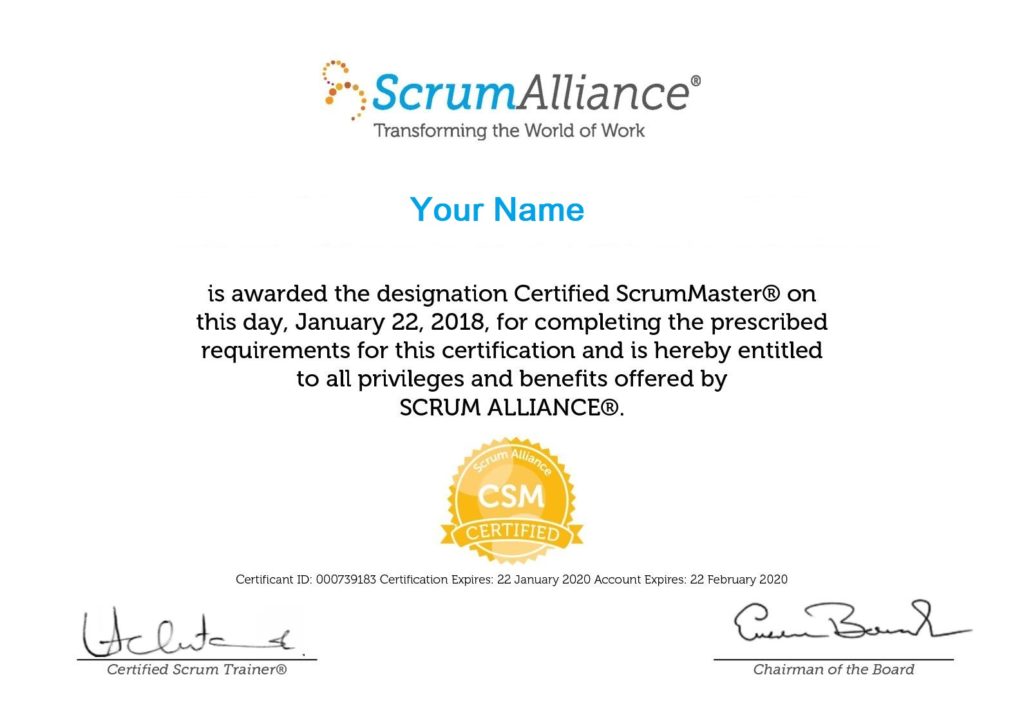
- Step 6 – Claim Your Credential: Accept the license agreement on the Scrum Alliance dashboard to instantly download your CSM certificate and secure your verifiable digital badge to showcase on LinkedIn.
SEU Renewal and the Delhi Agile Community
Your journey of learning does not stop once you pass the exam after your CSM Certification Training in Delhi. To ensure that the global pool of Certified ScrumMasters remains active, educated, and completely up-to-date with shifting tech industry trends, the Scrum Alliance requires you to renew your credential every two years. This process is designed to be highly rewarding and focuses entirely on your continuous professional development.
To renew the certification, you must accumulate 20 Scrum Education Units (SEUs) over the two-year period and pay a nominal renewal fee via the Scrum Alliance portal. Generally, one SEU equals one hour of active learning, reading, or giving back to the Agile community. Conveniently, by completing your initial 2-day CSM Certification Training in Delhi with EasyLearningTre, you automatically earn 20 PDUs and 20 SEUs, giving you a perfect understanding of how these continuing education credits function.
- Community Engagement: Delhi boasts a massive Agile community. Earn SEUs by attending live meetups organized by Agile networks in Connaught Place or South Delhi, or participating in global Scrum Alliance Regional Gatherings virtually.
- Self-Directed Study: You can earn SEUs by reading highly recommended books on Scrum, Agile coaching, or product management, and watching educational content in the Scrum Alliance resource library.
- Community Contribution: Volunteering, writing articles or blogs on Agile best practices, mentoring junior colleagues, or presenting case studies at your workplace all count towards your SEUs.
- Advancing Your Certifications: Earning a next-level Scrum Alliance credential, such as the CSPO (Certified Scrum Product Owner) or the A-CSM (Advanced Certified ScrumMaster), automatically renews your foundational CSM certification for another two years.
Acing the Scrum Master Interview in Delhi's Top Firms
Securing your CSM certification is a massive milestone, but landing a premium, high-paying role at a top Delhi IT firm or PSU requires you to demonstrate situational intelligence during grueling interviews. Hiring managers will rarely ask you to recite textbook definitions. Instead, they will present you with complex team dysfunctions and ask how you, as a Certified ScrumMaster, would resolve them. Our CSM Certification Training in Delhi is specifically designed to prepare you for these intense scenario-based evaluations.
During the workshop, your CST will guide you through authentic corporate case studies that mirror the exact questions asked by elite hiring managers:
- Handling Scope Creep Mid-Sprint: Formulating exact strategies on how to respectfully push back on a demanding government stakeholder who tries to add urgent requirements into an active Sprint, and determining when a Sprint cancellation is actually justified.
- Reviving Zombie Daily Scrums: Proven, actionable techniques to transform monotonous "status update" meetings back into energized, 15-minute synchronization huddles owned entirely by the Developers.
- Coaching an Overwhelmed Product Owner: Learning how to support a Product Owner who lacks time for Backlog Refinement, which typically leads to vague User Stories and disastrous Sprint Planning sessions.
- Resolving Cross-Functional Conflict: Implementing advanced coaching frameworks to mediate severe technical disagreements between backend developers and UI/UX designers while preserving team autonomy and psychological safety.
By mastering the strict rules of the Scrum Guide and understanding how to apply them to these complex human scenarios via CSM Certification Training in Delhi, you graduate fully prepared to ace tough interviews and lead high-performing Agile teams from day one in India's highly competitive tech ecosystem.