The Definitive Guide to ISO 9001 Lead Auditor Certification
Transform organizational chaos into streamlined excellence. Discover how the ISO 9001 Lead Auditor Training empowers professionals to drive global compliance, mitigate risks, and elevate Quality Management Systems (QMS).
Demystifying ISO 9001: The Backbone of Global Trade
In a hyper-competitive global market, consistency is the ultimate currency. Whether a consumer is purchasing a microchip from Taiwan, automotive parts from Germany, or software services from India, they expect a standardized level of quality. The International Organization for Standardization (ISO) created the ISO 9001 standard to ensure exactly this. It is not a standard for creating a *product*; it is a standard for creating a *system* that consistently produces quality products. Today, over one million organizations globally are certified to ISO 9001.
However, an organization cannot simply declare itself compliant. It must be rigorously tested and verified by an independent, objective expert. This is the critical role of the ISO 9001 Lead Auditor. By pursuing your ISO 9001 Lead Auditor Certification Training, you transition from being a passive participant in corporate quality programs to an authoritative evaluator. You learn how to dissect an organization’s operations, interview top management, trace process flows, and determine whether the company's QMS truly meets the stringent requirements of the international standard.
Attempting to master the art of auditing through self-study is virtually impossible because auditing is a fundamentally human-centric skill. A formal ISO 9001 Lead Auditor Training program provides a highly structured, 5-day immersive experience. Guided by veteran Lead Assessors who have audited hundreds of international firms, you won't just memorize the clauses of the standard; you will learn the psychology of auditing. How do you handle a hostile auditee? How do you write a non-conformity report that management cannot dispute? Our training ensures you master these practical, on-the-ground auditing tactics.
The Evolution: ISO 9001:2015 and Risk-Based Thinking
The ISO 9001 standard underwent a massive evolution in 2015. Previous versions were heavily criticized for focusing too much on rigid documentation, leading companies to create "manuals" that gathered dust on a shelf. The 2015 update revolutionized the standard by introducing the High-Level Structure (Annex SL) and a profound new concept: Risk-Based Thinking.
During your ISO 9001 Lead Auditor Certification Training, you will deeply explore this paradigm shift. You will learn that the modern standard no longer requires a "Quality Manual." Instead, it requires organizations to proactively identify risks and opportunities that could impact their ability to deliver quality products. As an auditor, you must now evaluate how top management (leadership) integrates QMS into their strategic business direction. You are no longer just checking if a document is signed; you are verifying if the organizational culture actually prioritizes quality and risk mitigation.
Anatomy of the Standard: The PDCA Cycle and Clauses 4 to 10
The entire ISO 9001 framework is built upon the famous Deming Cycle: Plan-Do-Check-Act (PDCA). To audit a system, you must profoundly understand this structure. Let's break down exactly what you will master during your training:
Plan (Clauses 4, 5, 6)
You will learn to audit the Context of the Organization (Clause 4), ensuring the company understands internal/external issues and stakeholder needs. You will evaluate Leadership (Clause 5), checking if top management is accountable for the QMS. Crucially, you will audit Planning (Clause 6), verifying how the company addresses risks and sets measurable Quality Objectives.
Do (Clauses 7, 8)
This covers the execution phase. You will audit Support (Clause 7), including resources, competence, awareness, and documented information. Then you will dive into Operation (Clause 8), the core of the business. You will learn to audit the design and development processes, control of external providers (supply chain), and production/service provision.
Check (Clause 9)
How does the company know if its QMS is working? You will master the auditing of Performance Evaluation (Clause 9). This involves assessing how the company monitors customer satisfaction, conducts internal audits, and executes formal Management Reviews to ensure ongoing alignment with strategic goals.
Act (Clause 10)
The hallmark of a great QMS is how it reacts to failure. You will audit Improvement (Clause 10). You will learn how to forensically examine Non-Conformities and Corrective Actions (CAPA). As an auditor, you must verify that the organization doesn't just fix the immediate problem, but identifies the root cause to prevent recurrence.
The Art of Auditing: First, Second, and Third-Party Audits
One of the most critical aspects of our ISO 9001 Lead Auditor Certification Training is understanding the different types of audits and your role within them. The training follows the ISO 19011 guidelines for auditing management systems.
- First-Party Audits (Internal Audits): You audit your own organization to prepare for external certification or to drive internal continuous improvement. The training teaches you how to maintain objectivity even when auditing your own colleagues.
- Second-Party Audits (Supplier Audits): Organizations must ensure their supply chain is robust. You will learn how to travel to a supplier's facility and audit their QMS to verify they can reliably deliver parts or services to your company.
- Third-Party Audits (Certification Audits): The pinnacle of the profession. Working for a Certification Body (like BSI, Intertek, or TUV), you visit a client to determine if they deserve to be awarded the official ISO 9001 certificate. You will learn the strict rules of Stage 1 (Documentation Review) and Stage 2 (Main Audit) certification processes.
Your Blueprint to Becoming an IRCA Registered Auditor
Completing the 5-day course is the first massive step toward a lucrative career. By enrolling in our ISO 9001 Lead Auditor Certification Training, you receive a clear, step-by-step roadmap to achieving global recognition:
- Step 1: Foundational Knowledge. Before day one, familiarize yourself with the seven Quality Management Principles (Customer Focus, Leadership, Engagement of People, Process Approach, Improvement, Evidence-based Decision Making, Relationship Management).
- Step 2: The 5-Day Intensive Workshop. Attend the 40-hour live training. You will participate in intense role-playing scenarios. You will act as the Lead Auditor, managing opening meetings, interviewing stubborn "employees," and gathering objective evidence.
- Step 3: Continuous Assessment. Unlike purely academic courses, you are graded every single day. The instructor evaluates your teamwork, communication skills, and your ability to accurately draft Non-Conformity (NC) reports using the PLO (Problem, Location, Objective Evidence) format.
- Step 4: The Final Examination. On the final day, you will sit for the written/online examination. It tests your knowledge of the standard, audit planning, and your ability to categorize findings as Major NCs, Minor NCs, or Observations.
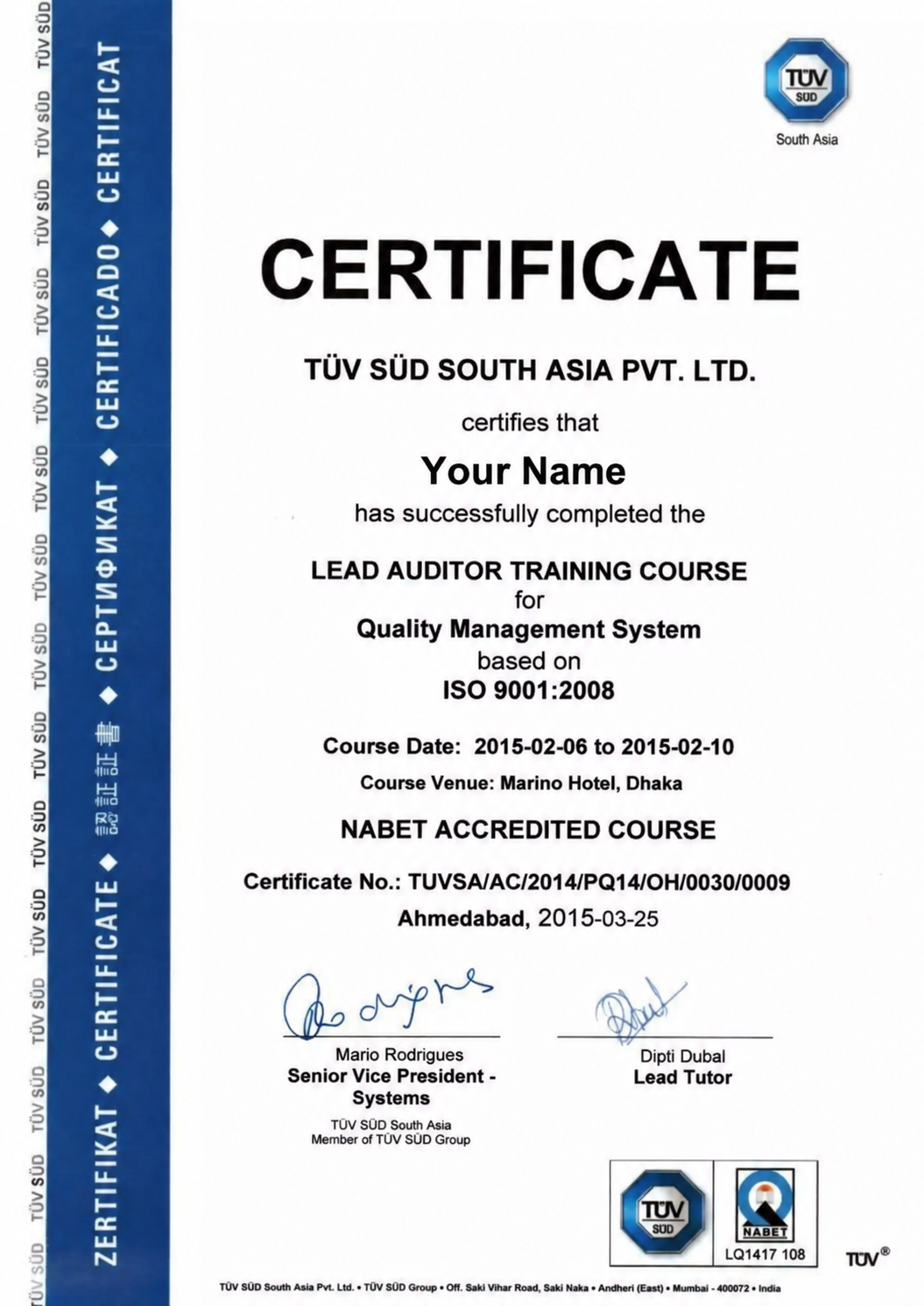
- Step 5: CQI & IRCA Registration (Optional but Recommended). Once you pass, you receive a Certificate of Achievement. To become a fully Registered Lead Auditor, you must submit a log to the CQI/IRCA detailing actual 3rd-party audits you have performed in the industry.
The Economic Impact: Salary Surges and Industry Demand
Investing in your education via the ISO 9001 Lead Auditor Certification Training yields an incredibly high Return on Investment (ROI). Because ISO 9001 certification is often a mandatory prerequisite to bid on lucrative government contracts or supply to massive OEMs (Original Equipment Manufacturers), organizations are legally and financially compelled to hire certified auditors.
Lead Auditors are aggressively recruited by global Certification Bodies, multinational manufacturing conglomerates, and consulting firms. You will be positioned for high-paying roles such as Quality Assurance Director, QMS Consultant, Vendor Compliance Manager, and Lead Assessor. Because the credential proves you can independently verify complex systems, ISO 9001 Lead Auditors consistently command premium compensation and enjoy massive opportunities for international travel.
Why Partner with EasyLearning Tre for Your Auditing Education?
Auditing is not about finding faults; it is about verifying facts. Relying purely on reading the standard will not prepare you for the intense reality of a live audit. A manager might try to hide evidence, or a department head might misunderstand the standard entirely. As a leading ed-tech platform, our ISO 9001 Lead Auditor Certification Training is explicitly designed to build your investigative and diplomatic skills.
We utilize elite instructors who possess decades of active third-party auditing experience. We provide continuous mentorship, high-pressure audit simulations, a vibrant alumni network, and a 100% exam pass support structure because we are immensely confident in our curriculum's quality. Master the science of Quality Management Systems, elevate your resume to the assessor level, and secure your future as a guardian of global quality today.