Demystifying ISO 22301: The Global Standard for Organizational Resilience
Transform organizational vulnerability into verifiable continuity. Discover how the ISO 22301 Lead Auditor Training empowers professionals to drive global compliance, audit disaster recovery protocols, and elevate Business Continuity Management Systems (BCMS).
Why Business Continuity is a Boardroom Mandate?
In a volatile global economy, disruption is no longer a probability; it is an absolute certainty. Whether an organization faces a targeted ransomware attack, a devastating hurricane, a global pandemic, or a sudden collapse of a critical supplier, the ability to survive and recover rapidly is the ultimate competitive advantage. The International Organization for Standardization (ISO) created the ISO 22301 standard to ensure organizations don't just "hope for the best" during a crisis. It provides a rigorous framework for a Business Continuity Management System (BCMS) designed to protect an organization from disruptive incidents, reduce the likelihood of these incidents, and ensure recovery is executed efficiently.
However, an organization cannot simply draft a Business Continuity Plan (BCP), put it in a drawer, and declare itself resilient. The BCMS must be rigorously tested, exercised, and verified by an independent, objective expert. This is the critical role of the ISO 22301 Lead Auditor. By pursuing your ISO 22301 Lead Auditor Certification Training, you transition from being a tactical planner to an authoritative governance evaluator. You learn how to dissect an organization’s continuity strategies, interview top management, trace crisis response flows, and determine whether the company's BCMS truly meets the stringent requirements of international law and supply chain demands.
Attempting to master the art of continuity auditing through self-study is virtually impossible. A formal ISO 22301 Lead Auditor Training program provides a highly structured, 5-day immersive experience. Guided by veteran Lead Assessors who have audited hundreds of firms across critical infrastructure sectors, you won't just memorize the clauses of the standard; you will learn the psychology of auditing. How do you audit a crisis management team that claims their "tabletop exercise" was a success despite missing key metrics? How do you write a non-conformity report that the Board of Directors will take seriously? Our training ensures you master these practical, on-the-ground auditing tactics.
The Heart of BCMS: Auditing the Business Impact Analysis (BIA)
The core engine of any ISO 22301 implementation is Clause 8.2: The Business Impact Analysis (BIA) and Risk Assessment. Unlike other standards that focus solely on preventive risk, ISO 22301 demands that an organization knows exactly what happens when the absolute worst occurs.
During your ISO 22301 Lead Auditor Certification Training, you will deeply explore how to audit a BIA. As an auditor, you must verify that the organization has accurately identified its critical products and services. You will learn how to interrogate their recovery metrics: Are their Maximum Tolerable Period of Disruption (MTPD) calculations realistic? Have they set appropriate Recovery Time Objectives (RTO) and Recovery Point Objectives (RPO) for their IT systems? If a bank claims they can recover their main transaction server in 2 hours (RTO), but their BIA shows they only backup data every 24 hours (RPO), you must be trained to instantly spot this critical non-conformity.
Anatomy of a BCMS: Clauses 4 through 10
The entire ISO 22301 framework is built upon the High-Level Structure (Annex SL) and the Deming Cycle: Plan-Do-Check-Act (PDCA). To audit a system, you must profoundly understand this structure. Let's break down exactly what you will master during your training:
Plan (Clauses 4, 5, 6)
You will learn to audit the Context of the Organization (Clause 4), ensuring the company understands internal/external disruptive threats and legal/regulatory requirements. You will evaluate Leadership (Clause 5), checking if Top Management is actively engaged in continuity planning. Crucially, you will audit Planning (Clause 6), verifying how the company sets measurable Business Continuity Objectives.
Do (Clauses 7, 8)
This covers the execution phase. You will audit Support (Clause 7), including competence, awareness, and corporate communication strategies during a crisis. Then you will dive into Operation (Clause 8). Here, you will audit the BIA, the Risk Assessment, the formulation of Business Continuity Strategies, and the actual documentation of the Business Continuity Plans (BCP) and Incident Response protocols.
Check (Clause 9)
A BCP is useless if it has never been tested. You will master the auditing of Performance Evaluation (Clause 9). This involves assessing how the company conducts its Exercising and Testing programs. As an auditor, you must look for evidence of tabletop exercises, parallel testing, and full-scale interruption drills. You will also review their internal audits and Management Reviews.
Act (Clause 10)
How does the BCMS evolve after a test fails? You will audit Improvement (Clause 10). You will learn how to forensically examine Non-Conformities and Corrective Actions. If a disaster recovery drill failed because a backup generator didn't start, as an auditor, you must verify that the organization didn't just fix the generator, but identified the root cause (e.g., lack of maintenance schedules) to prevent recurrence.
The Art of Auditing: ISO 19011 and the BCMS Auditor
One of the most critical aspects of our ISO 22301 Lead Auditor Certification Training is understanding the different types of audits and your role within them. The training strictly follows the ISO 19011 guidelines for auditing management systems.
- First-Party Audits (Internal Audits): You audit your own organization to prepare for external certification or to drive internal continuous improvement. The training teaches you how to maintain strict objectivity even when auditing your own executive board's crisis preparedness.
- Second-Party Audits (Supplier Audits): The modern supply chain is incredibly fragile. You will learn how to travel to a critical vendor's facility and audit their BCMS to verify that if a disaster strikes their city, your company will still receive its necessary raw materials or cloud services.
- Third-Party Audits (Certification Audits): The pinnacle of the profession. Working for a Certification Body, you visit a client to determine if they deserve the official ISO 22301 certificate. You will learn the strict rules of Stage 1 (Documentation Review) and Stage 2 (Main Audit) certification processes.
Your Blueprint to Becoming a Registered Lead Auditor
Completing the 5-day course is the first massive step toward a lucrative career. By enrolling in our ISO 22301 Lead Auditor Certification Training, you receive a clear, step-by-step roadmap to achieving global recognition:
- Step 1: Foundational Knowledge. Before day one, familiarize yourself with basic BCP concepts, MTPD/RTO/RPO metrics, and read through the ISO 22301 standard clauses.
- Step 2: The 5-Day Intensive Workshop. Attend the 40-hour live training. You will participate in intense role-playing scenarios. You will act as the Lead Auditor, managing opening meetings, interviewing crisis management teams, and gathering objective evidence of continuity exercises.
- Step 3: Continuous Assessment. Unlike purely academic courses, you are graded every single day. The instructor evaluates your teamwork, communication skills, and your ability to accurately draft Non-Conformity (NC) reports using the PLO (Problem, Location, Objective Evidence) format.
- Step 4: The Final Examination. On the final day, you will sit for the written/online examination. It tests your knowledge of the standard, audit planning, and your ability to categorize findings as Major NCs, Minor NCs, or Observations based on complex disruption scenarios.
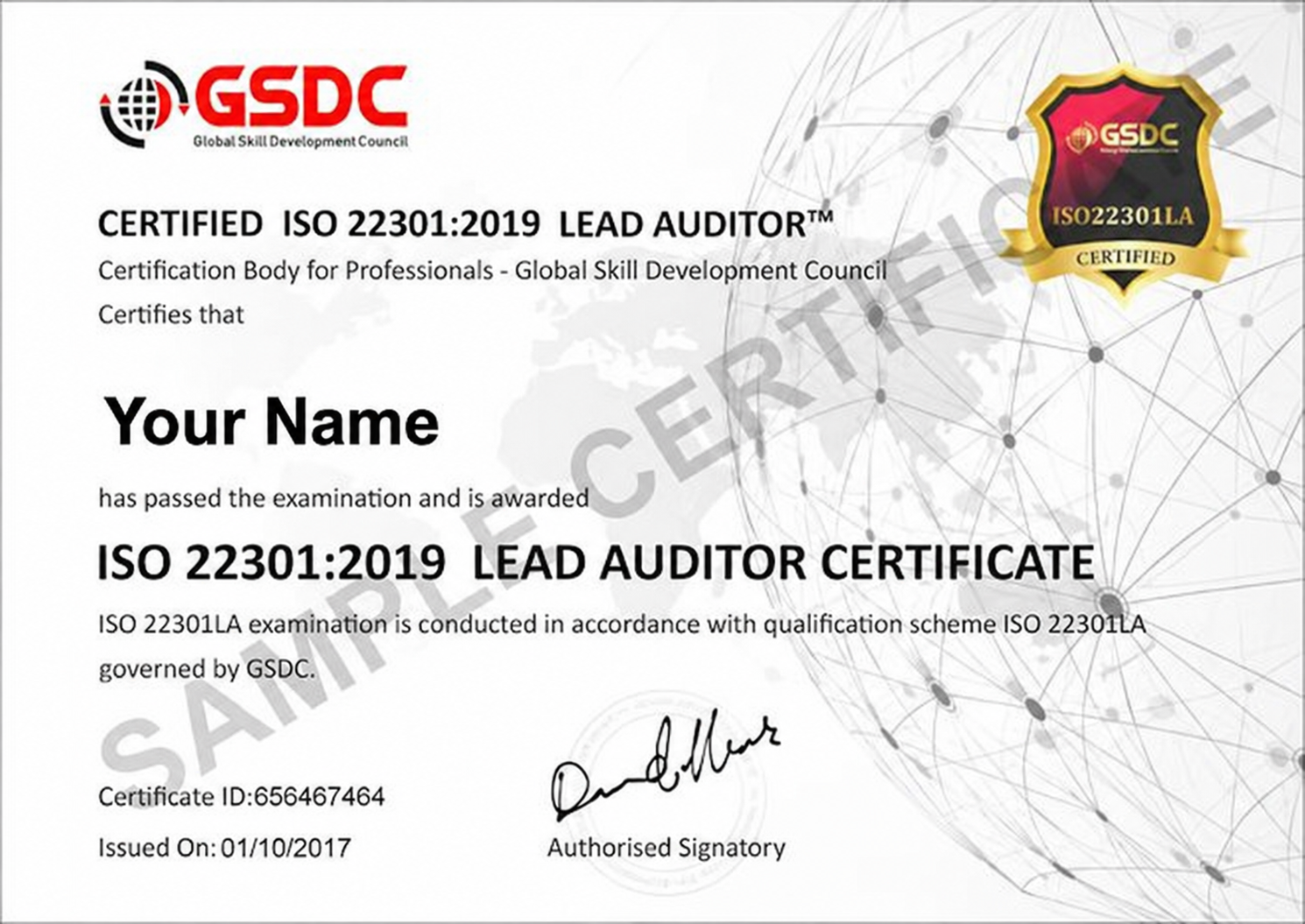
- Step 5: Professional Registration. Once you pass, you receive a Certificate of Achievement. To become a fully Registered Lead Auditor, you must submit a log detailing actual 3rd-party audits you have performed to your respective certification body.
ISO 22301 vs. ISO 27001: Understanding the Overlap
Professionals frequently debate which certification they should pursue first. The reality is that these two standards are highly synergistic.
Strategic Breakdown: The ISO 27001 (ISMS) standard focuses on protecting information (Confidentiality, Integrity, Availability) against cyber threats. The ISO 22301 (BCMS) standard focuses on the survival of the *entire business* (IT, HR, Operations, Facilities) against any type of threat (fire, flood, strike, cyber). If a ransomware attack occurs, ISO 27001 processes contain the breach, but ISO 22301 processes ensure the business continues operating while the IT systems are down. Holding Lead Auditor credentials in both makes you the ultimate enterprise resilience authority, highly coveted by the Big 4 consulting firms.
The Economic Impact: Global Demand for BCMS Auditors
Investing in your education via the ISO 22301 Lead Auditor Certification Training yields an incredibly high Return on Investment (ROI). Because supply chain disruptions and extreme weather events are accelerating globally, massive corporations (like automotive OEMs and global banks) are legally mandating that all their tier-1 suppliers achieve ISO 22301 certification. They cannot afford their vendors going offline.
Lead Auditors are aggressively recruited by global Certification Bodies, financial institutions, and specialized resilience consulting firms. You will be positioned for high-paying roles such as Business Continuity Director, Crisis Management Consultant, Vendor Resilience Manager, and Lead Assessor. Because the credential proves you can independently verify an organization's ability to survive a catastrophe, ISO 22301 Lead Auditors consistently command premium compensation and enjoy immense job security.
Why Partner with EasyLearning Tre for Your Auditing Education?
Auditing a Business Continuity system is inherently complex because you are auditing processes for events that (hopefully) rarely happen. Relying purely on reading the standard will not prepare you for the intense reality of verifying a company's disaster recovery drill. As a leading ed-tech platform, our ISO 22301 Lead Auditor Certification Training is explicitly designed to build your investigative and critical-thinking skills.
We utilize elite instructors who possess decades of active third-party auditing and crisis management experience. We provide continuous mentorship, high-pressure audit simulations, a vibrant alumni network, and a 100% exam pass support structure because we are immensely confident in our curriculum's quality. Master the science of Business Continuity Management Systems, elevate your resume to the assessor level, and secure your future as a guardian of global enterprise survival today.