The Strategic Imperative of CRISC Certification Training
Bridge the gap between deep technical flaws and Board-level financial impacts. Discover how CRISC transforms IT professionals into elite Enterprise Risk Managers capable of safeguarding global operations.
Why Enterprise Risk Management (ERM) is the New Frontier?
In the modern corporate ecosystem, risk is no longer an afterthought relegated to a basement IT department; it is a primary Board-level conversation. The explosion of sophisticated supply chain attacks, devastating ransomware syndicates, and sudden geopolitical shifts has made executives realize that IT risk *is* business risk. An unpatched server doesn't just mean a technical outage; it means lost revenue, shattered brand reputation, and massive regulatory fines. This paradigm shift has created an unprecedented demand for professionals who hold the Certified in Risk and Information Systems Control (CRISC) credential.
Unlike purely technical certifications that teach you how to configure a firewall, the CRISC focuses on the "bigger picture." By pursuing your CRISC Certification Training, you transition from being a reactive problem-solver to a proactive strategic navigator. You learn how to identify threats before they materialize, assess their potential financial and operational impact, and design cost-effective controls that mitigate those risks without bringing business operations to a grinding halt.
Attempting to master the complex ISACA terminology and risk frameworks purely through self-study is a notoriously frustrating endeavor. A formal CRISC Certification Training program provides a highly structured, immersive experience. Guided by industry veterans who have designed Enterprise Risk Management (ERM) programs for Fortune 500 companies, you won't just memorize definitions; you will learn how to apply them. How do you calculate Annualized Loss Expectancy (ALE)? When should an enterprise *accept* a risk rather than *mitigate* it? Our training ensures you master this critical decision-making logic.
Anatomy of the CRISC Exam: The 4 Critical Domains
The ISACA CRISC exam is lean, focused, and intensely strategic. It is divided into four updated domains that reflect the actual lifecycle of risk management within an enterprise. Let's break down exactly what you will master during your CRISC Certification Training:
Domain 1: Governance (26%)
Risk management cannot exist in a vacuum; it must be driven from the top down. In this domain, you will explore Organizational Strategy, Goals, and Objectives. You will learn how to define an organization's Risk Appetite and Risk Tolerance, understand the Three Lines of Defense model, and navigate complex legal, regulatory, and contractual requirements that dictate how data must be governed.
Domain 2: IT Risk Assessment (20%)
How do you find the hidden dangers in your network? This module covers the core of Risk Identification, Analysis, and Evaluation. You will learn to perform threat modeling, vulnerability assessments, and calculate risk using both qualitative (High/Medium/Low) and quantitative (financial metrics) methodologies. Crucially, you will learn how to build and maintain a dynamic Risk Register.
Domain 3: Risk Response and Reporting (32%)
Once a risk is identified, what do you do about it? This heavily weighted domain teaches you the four primary risk responses: Mitigate, Transfer, Accept, and Avoid. You will learn how to design Information Systems controls, implement them, and most importantly, establish Key Risk Indicators (KRIs) to report the ongoing status of these risks to executive stakeholders clearly and effectively.
Domain 4: Information Technology and Security (22%)
A risk manager must understand the technology they are protecting. This domain bridges the gap into enterprise architecture. You will explore network security, cloud computing risks, the System Development Life Cycle (SDLC), and data privacy architectures. You will also dive deep into Business Continuity Planning (BCP) and Disaster Recovery (DR) to ensure resilience during a crisis.
Aligning IT Risk with Business Objectives
One of the most valuable lessons imparted during our CRISC Certification Training is the concept of Business Alignment. A common failure in traditional IT departments is implementing extremely restrictive security controls that paralyze the business—for example, making a sales portal so secure that actual customers cannot log in. This is a failure of risk management.
A CRISC professional understands that the goal of risk management is not to eliminate all risk (which is impossible), but to bring risk down to an acceptable level that allows the business to generate revenue safely. During the training, you will utilize complex case studies to learn how to translate deeply technical vulnerabilities (like a zero-day exploit in an Apache server) into business terms (like the potential loss of e-commerce revenue per hour), allowing the Board of Directors to make informed funding decisions regarding security controls.
Your Blueprint to Becoming a Certified Risk Professional
Earning the CRISC credential requires a combination of proven experience and exam mastery. Our CRISC Certification Training removes the confusion from the ISACA bureaucracy and provides a clear, step-by-step roadmap to your success:
- Step 1: Understand the Experience Requirement. You need 3 years of cumulative work experience across at least two of the four CRISC domains. However, you can (and many do) take and pass the exam *before* you have accumulated this experience!
- Step 2: Engage in Formal Training. Attend our 32-hour live immersive workshop. We decode the dense ISACA CRISC Review Manual into practical, real-world risk scenarios.
- Step 3: Register Strategically. Create your ISACA account and register for the exam. We advise purchasing an ISACA membership first, as the member discount on the exam fee is substantial.
- Step 4: Master the "ISACA Logic". Utilize our advanced simulation exams. ISACA questions are famous for offering four technically correct answers and asking for the "BEST" managerial action. Our mock tests train your brain to spot the correct executive response.
- Step 5: Conquer the Exam. Sit for the 4-hour, 150-question exam at a PSI testing center or via online proctoring. Achieve the scaled score of 450 out of 800.
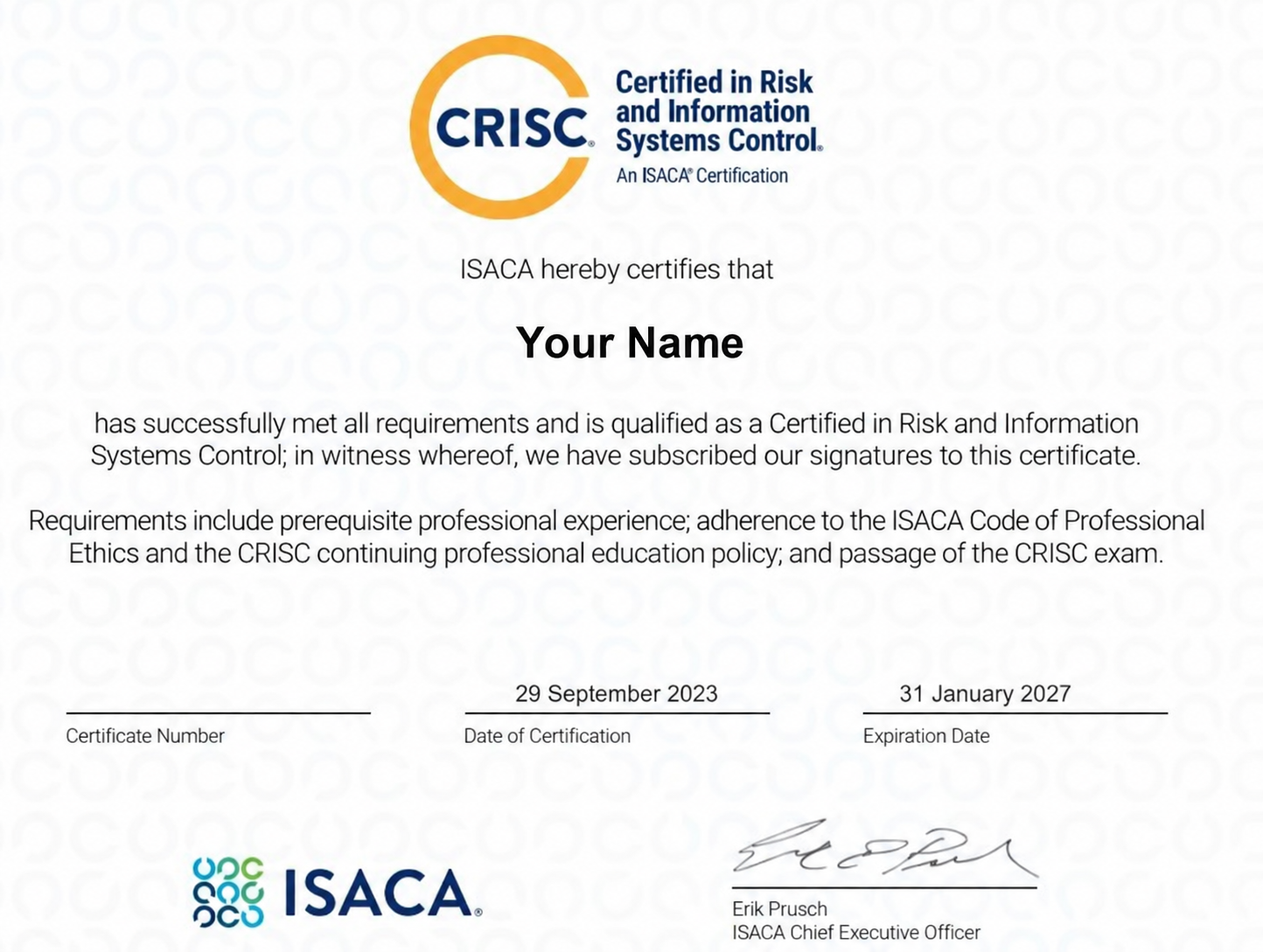
- Step 6: Submit for Certification. After passing, submit your application with verified proof of your 3 years of work experience to officially claim your CRISC title.
CRISC vs. CISA vs. CISM: Decoding the ISACA Ecosystem
Professionals frequently struggle to choose between ISACA's "Big Three" certifications. Understanding the distinction is vital for your career trajectory.
Strategic Breakdown: Think of the enterprise as a complex machine. The CISM (Security Manager) is the architect who builds the security systems protecting the machine. The CISA (Auditor) is the independent inspector who looks back at historical data to verify the machine was built correctly and complies with laws. The CRISC (Risk Manager) is the forward-looking visionary. The CRISC anticipates what could break the machine tomorrow, evaluates the financial impact, and proactively designs controls to prevent the failure. If you want to be the professional who anticipates threats and advises the C-suite on future investments, CRISC is your ultimate credential.
The Economic Impact: Salary Surges and Global Demand for Risk Experts
Investing in your education via the CRISC Certification Training yields an incredibly high Return on Investment (ROI). Because regulatory bodies worldwide are heavily penalizing companies for data breaches and poor risk oversight, organizations are legally and financially compelled to hire certified risk managers.
In the global market, CRISC professionals are aggressively recruited for roles such as Enterprise Risk Manager, IT Compliance Director, Business Information Security Officer (BISO), and Senior Risk Analyst. According to multiple global IT salary surveys, CRISC consistently ranks among the top 5 highest-paying IT certifications worldwide. The credential proves to employers that you can safeguard their most critical assets while enabling business agility.
Keeping Your Edge: The CRISC Continuing Education (CPE) Policy
The threat landscape changes every single day, and ISACA requires you to stay at the cutting edge. Once you pass your exam after completing the CRISC Certification Training, you must maintain your credential to keep it active.
You are required to earn 120 Continuing Professional Education (CPE) hours over a 3-year reporting period (with a minimum of 20 CPEs earned annually). You can earn these by attending risk management webinars, participating in ISACA chapter events, contributing to industry whitepapers, or passing related certifications. Additionally, you must adhere to the ISACA Code of Professional Ethics and pay an annual maintenance fee.
Why Partner with EasyLearning Tre for Your Risk Education?
The CRISC exam is notoriously tricky because it requires you to abandon purely technical thinking and adopt a business-first mindset. Relying on self-study often results in candidates failing because they chose the "best technical fix" rather than the "best risk-aligned business decision." As a leading ed-tech platform, our CRISC Certification Training is explicitly designed to build this Executive Risk Mindset.
We utilize elite instructors who possess decades of active Enterprise Risk Management experience. We provide continuous mentorship, a vibrant alumni network, and a 100% money-back guarantee because we are immensely confident in our curriculum's quality. Master the science of IT risk, elevate your resume to the strategic tier, and secure your future in the world's most critical tech discipline today.