The Ultimate Guide to CEH Certification Training
Step into the mind of a hacker. Discover the deep technical phases of ethical hacking, the evolution of CEH v12, and the exact strategies required to conquer the EC-Council examination.
Demystifying CEH: A Launchpad for Ethical Hackers
The cyber threat landscape is evolving at a terrifying pace. Malicious actors are utilizing advanced AI, automated exploit kits, and sophisticated social engineering to breach enterprise networks daily. To stop a hacker, you must learn to think like one. This is exactly what the Certified Ethical Hacker (CEH) credential, developed by the EC-Council, aims to achieve. It is not just a certification; it is a profound mindset shift that transitions IT professionals into elite cyber warriors.
Historically, organizations relied on passive defense mechanisms—firewalls, antivirus software, and intrusion detection systems (IDS). However, passive defense is no longer enough. By pursuing your CEH Certification Training, you acquire the capability to perform offensive security. You learn the exact tools, techniques, and methodologies (TTMs) used by malicious black-hat hackers, but you use them legally and ethically to identify and patch vulnerabilities before they can be exploited.
Unlike purely theoretical courses, a formal CEH Certification Training program is intensely hands-on. Over 40 hours of rigorous instruction, you will interact with real-world scenarios. You won't just read about SQL injections; you will execute them in safe, sandboxed environments. This dual approach of theoretical mastery and practical execution ensures that you are battle-ready the moment you step into a Security Operations Center (SOC).
The Evolution: CEH v12 and the "Learn, Certify, Engage, Compete" Framework
The EC-Council recently revolutionized ethical hacking training with the release of CEH version 12. Recognizing that reading a textbook is insufficient to stop a live cyber attack, CEH v12 introduced a comprehensive learning methodology: Learn, Certify, Engage, and Compete.
During your CEH Certification Training, you will first *Learn* through 20 updated modules covering everything from cloud security to IoT hacking. Next, you *Certify* by passing the rigorous 125-question exam. But the journey doesn't stop there. You then *Engage* by utilizing the new CEH Engage platform—a simulated environment where you execute a real-world vulnerability assessment against a fictitious organization. Finally, you *Compete* in global, month-long Capture the Flag (CTF) challenges to hone your skills against other ethical hackers worldwide.
This v12 update also places heavy emphasis on modern attack vectors. You will dive deep into MITRE ATT&CK frameworks, Diamond Model of Intrusion Analysis, Fileless Malware, Web API threats, and the security implications of edge computing. Our training ensures you are not learning yesterday's hacks, but tomorrow's defenses.
Deep Dive: The 5 Phases of Ethical Hacking
The core of the CEH exam revolves around a structured methodology. A high-quality CEH Certification Training program will drill these five phases into your muscle memory. Let's break down exactly what you will master:
Phase 1: Reconnaissance (Footprinting)
Hacking begins long before the first payload is fired. You will learn active and passive footprinting to gather critical intelligence about a target. From utilizing OSINT (Open Source Intelligence), Google Dorks, and Shodan, to scraping metadata and DNS enumeration, you will learn how hackers map an organization's entire digital footprint invisibly.
Phase 2: Scanning & Enumeration
Moving from passive to active. You will master tools like Nmap and Hping3 to scan for live hosts, open ports, and running services. You will learn to enumerate SNMP, LDAP, and SMB protocols to extract usernames, routing tables, and system information, effectively drawing a detailed map of the target network's architecture.
Phase 3: Gaining Access (Exploitation)
This is where the breach happens. Based on the vulnerabilities discovered, you will learn to execute attacks. This module covers password cracking (Rainbow tables, dictionary attacks), buffer overflows, privilege escalation, and utilizing the Metasploit framework to deploy payloads that bypass endpoint detection and response (EDR) systems.
Phase 4: Maintaining Access
Hackers don't want to break in just once; they want to stay. You will explore how advanced persistent threats (APTs) deploy rootkits, trojans, and backdoors to maintain covert access. You will learn the mechanics of steganography and alternate data streams to hide malicious files in plain sight.
Phase 5: Clearing Tracks. The final phase of a successful hack is erasing all evidence. During the training, you will learn how attackers manipulate audit logs, alter timestamps, and use proxy chains/VPNs to mask their IP addresses, and crucially, how incident responders can uncover these hidden tracks using digital forensics.
Navigating the Lab Environment: EC-Council iLabs
Theoretical knowledge is useless if you cannot execute a command in a Linux terminal under pressure. This is why our CEH Certification Training includes 6 months of direct access to EC-Council's official iLabs. iLabs is a cloud-based, sandboxed environment packed with over 3,500 hacking tools and operating systems (including Kali Linux, Windows Server, and vulnerable web apps).
Instead of risking your own local network, you will safely practice devastating attacks. You will physically execute Man-in-the-Middle (MITM) attacks, deploy ransomware simulations, and perform Wi-Fi cracking (WPA2/WPA3). This hands-on lab time is the exact differentiator that transforms a beginner into a confident, job-ready Penetration Tester.
The Step-by-Step CEH Certification Roadmap
Achieving your credential requires dedication. By enrolling in our CEH Certification Training, you receive end-to-end guidance. Here is the exact roadmap to your success:
- Step 1: Check Eligibility. To take the exam, you either need 2 years of proven infosec experience, OR you can completely bypass this requirement by taking official EC-Council training with us.
- Step 2: Complete the 40-Hour Training. Attend our live immersive workshop. We decode the heavy CEH courseware into practical, engaging hacking sessions.
- Step 3: Receive Your Exam Voucher. Upon completion of the training, you will receive an official EC-Council exam voucher.
- Step 4: Rigorous Mock Testing. Utilize our advanced simulation exams. You must get used to the timing (125 questions in 4 hours) and the structure of EC-Council's questioning.
- Step 5: Pass the Exam. Schedule your exam either at a Pearson VUE center or via online proctoring. Achieve the passing score (usually between 60% and 85%) to earn your title.
- Step 6: Aim for CEH Master (Optional). After passing the written exam, you can challenge the 6-hour CEH Practical exam. Passing both grants you the prestigious CEH Master credential.
CEH vs. OSCP: Which Path is Right For You?
Professionals frequently debate which offensive security certification is best. The CompTIA Security+ is too basic, while the Offensive Security Certified Professional (OSCP) is notoriously brutal. The CEH sits perfectly in the middle, making it the highest ROI certification for mid-level professionals.
Strategic Advantage: The OSCP is an entirely practical, 24-hour hacking exam that requires immense prior technical knowledge and scripting ability. It is highly respected but extremely difficult for beginners. The CEH, however, focuses on providing a massive, comprehensive overview of all hacking vectors, tools, and defensive strategies. CEH is the "dictionary" of hacking. It gets you past HR filters, meets government compliance requirements, and builds the foundational knowledge you need *before* you attempt a grueling exam like the OSCP.
Career Trajectory: Salaries, Demand, and DoD Directives
Investing in your education via the CEH Certification Training yields a massive Return on Investment (ROI). The CEH is specifically recognized by the US Department of Defense (DoD 8570/8140 directives) for multiple Cyber Defense Service Provider (CSSP) roles, making it invaluable for defense contractors worldwide.
In the private sector, Certified Ethical Hackers are aggressively recruited for roles such as Penetration Tester, Vulnerability Assessor, Network Security Engineer, and SOC Analyst. Because the exam proves you can identify critical flaws before malicious hackers exploit them, organizations trust you with their most sensitive infrastructure. Consequently, CEH credential holders routinely command six-figure salaries globally.
Maintaining Your CEH: The ECE Program
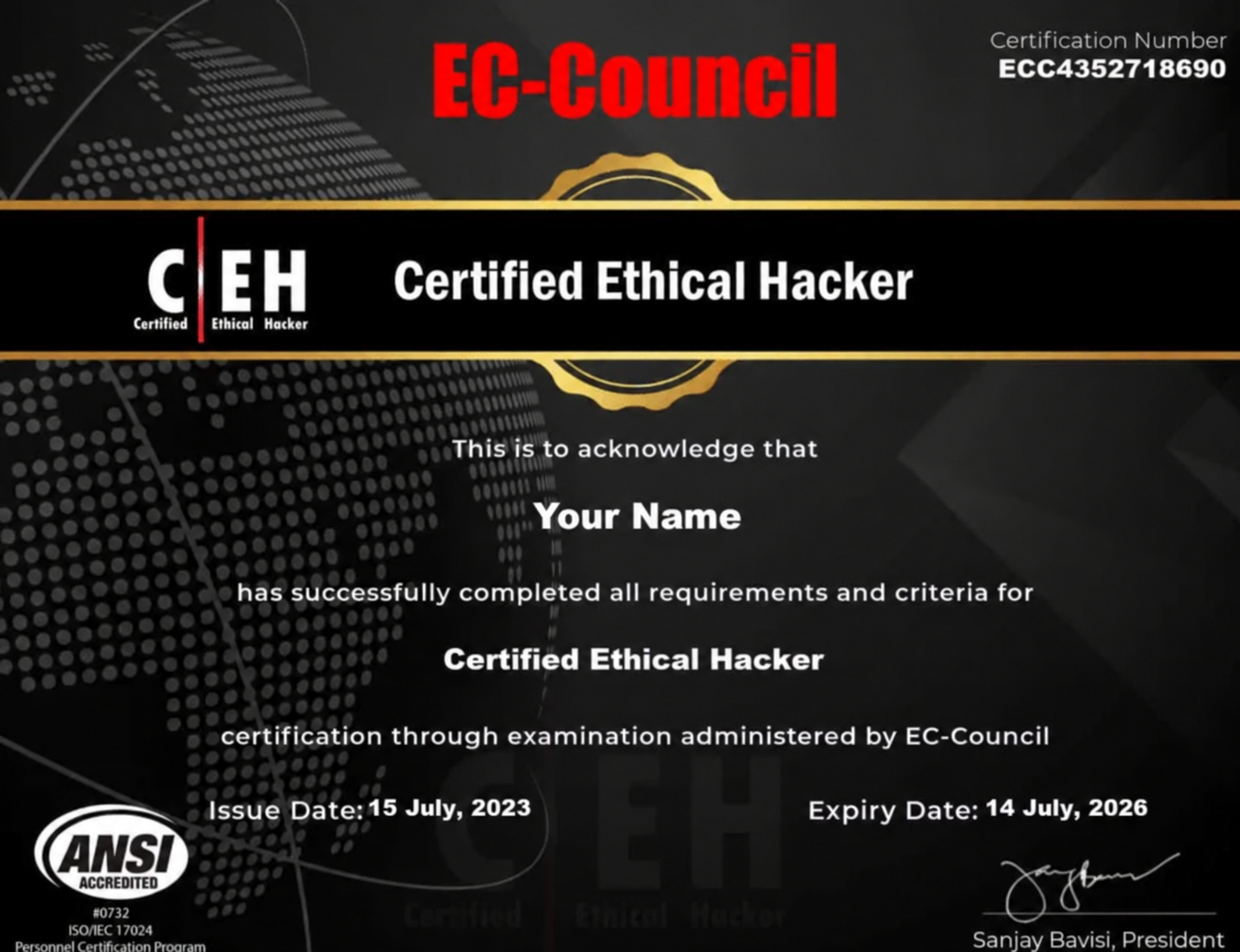
The cyber landscape evolves daily, and EC-Council requires you to evolve with it. Once you pass your exam after completing the CEH Certification Training, your credential is valid for three years. To renew it, you must participate in the EC-Council Continuing Education (ECE) program.
You are required to earn 120 ECE credits over the 3-year cycle. You can earn these by attending cybersecurity webinars, writing whitepapers, reading industry books, or taking advanced specialized courses. Additionally, you must pay an Annual Membership Fee of $80 USD to maintain your active status and access to the global EC-Council community.
Why EasyLearning Tre for Your CEH Certification Training?
The CEH is a highly technical certification. Watching generic video recordings will not prepare you for the nuances of Nmap scripting or Metasploit payload generation. Our CEH Certification Training is designed to build real-world, terminal-level competency. We utilize elite Authorized Training Partners and instructors who actively work as Penetration Testers in the industry.
We provide continuous support, 6 months of interactive iLabs access, and a 100% money-back guarantee because we are immensely confident in our curriculum's quality. Don't let cyber threats intimidate you. Master the art of ethical hacking, elevate your resume, and become the ultimate defender of the digital realm today.